
HP MJF 1200: طباعة ثلاثية الأبعاد صناعية تصل إلى مساحة عمل الهندسة
HP MJF 1200: Industrial 3D Printing Comes to the Engineering Workspace
\n\n\nThe manufacturing industry has long faced a persistent challenge: the gap between design thinking and physical production. A designer might have a revolutionary idea on Monday, but the revised prototype won’t arrive from the external bureau until Friday. By then, the decision window has closed, and the iteration that could have changed everything arrives too late to matter.
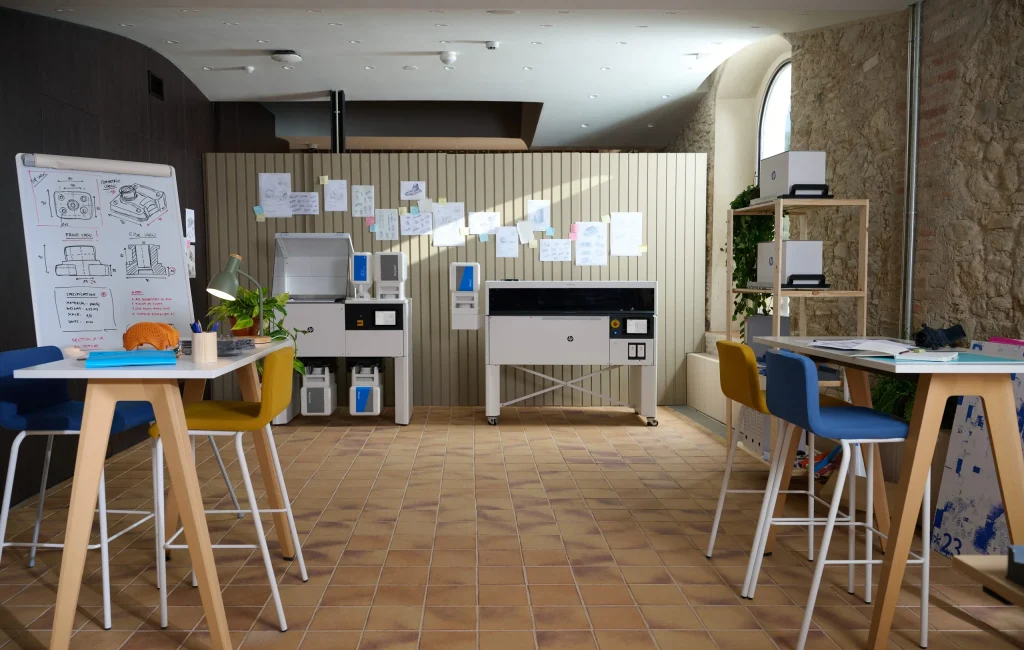
\n\nAt Rapid + TCT 2026, HP Additive Manufacturing Solutions announced the MJF 1200 3D printer — a compact system designed to bridge this gap by bringing industrial-grade Multi Jet Fusion technology directly into engineering workspaces and design studios.
\n\nWhat Makes the MJF 1200 Different?
\n\nUnlike traditional industrial 3D printers that require dedicated facilities, specialized ventilation, and trained operators, the MJF 1200 is engineered for clean environments. With a 12-liter build volume and largely automated workflows — including unpacking, material mixing, and build preparation — it integrates seamlessly into existing design processes.
\n\nEarly testers at Anima Design reported being able to validate designs “without changing our workflows,” which precisely describes what in-house industrial additive manufacturing has historically failed to deliver.
\n\nThe Economics of Faster Iteration
\n\nBringing manufacturing capability in-house fundamentally changes the economics of product development. Every day spent waiting for an external supplier is a day the iteration cycle isn’t moving. When teams can design, test, revise, and repeat without coordination overhead or lead times, they compress the distance between concept and validated product.
\n\nThis acceleration has real consequences for how quickly organizations can respond to market signals, customer feedback, or competitive pressures. In industries where speed to market determines success, the MJF 1200 represents a strategic advantage.
\n\nHealthcare Applications: Beyond Product Development
\n\nLualdi Labs, which tested the MJF 1200 in a medical context, framed its value in terms that go beyond efficiency. Their goal is to bring advanced manufacturing closer to the point of treatment, enabling clinicians to access personalized solutions more quickly. In healthcare, the cost of waiting isn’t a delayed sprint — it’s a delayed outcome for a patient.
\n\nHP’s Broader 3D Printing Ecosystem
\n\nThe MJF 1200 is part of HP’s comprehensive additive manufacturing strategy. The company also announced:
\n\n- \n
- Jet Fusion 5600 Series — Now featuring High Productivity print mode that increases output by 20%, plus Dual Tone technology for printing in two colors within a single build \n
- Industrial Filament 3D Printer 600 HT — Generally available in the US and Canada, designed for high-temperature polymers across aerospace, oil and gas, medical, and automotive applications \n
- HP 3D High Reusability PA12 Glass Beads — New material for increased stiffness and reduced weight in production parts \n
What This Means for Custom 3D Printing Services
\n\nWhile the MJF 1200 targets in-house manufacturing, it validates the growing demand for rapid prototyping and production-grade 3D printing. At TT3DPrint, we’re seeing similar trends from our clients — the need for faster turnaround times, higher quality functional parts, and materials that perform in real-world applications.
\n\nOur FDM printing services already deliver production-quality parts for custom projects ranging from educational models to industrial components. As technology like HP’s MJF 1200 becomes more accessible, we expect to see even more innovative applications emerge across industries.
\n\nConclusion
\n\nHP’s MJF 1200 represents a significant step toward democratizing industrial 3D printing. By bringing Multi Jet Fusion technology into the engineering workspace, HP is enabling faster iteration cycles, reducing production delays, and ultimately accelerating innovation.
\n\nThe printer is expected to be available in early 2027, giving teams time to evaluate how it might fit into their development processes. In the meantime, the trend toward accessible, production-grade 3D printing continues to accelerate — and that’s good news for innovators everywhere.
\n\nLooking for custom 3D printing services? Contact TT3DPrint to discuss your project requirements. We offer FDM printing with a wide range of materials and finishes, delivering production-quality parts for clients worldwide.


