Elegoo Secures $73M to Challenge Bambu Lab in Consumer 3D Printing
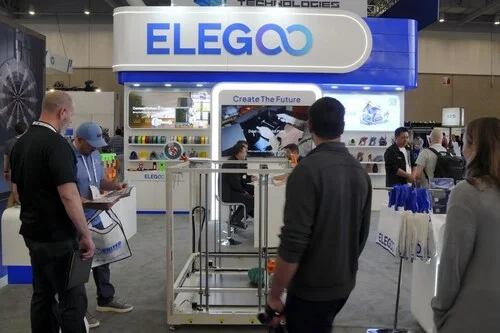
Elegoo Secures $73M to Challenge Bambu Lab’s Dominance in Consumer 3D Printing
The consumer 3D printing landscape is shifting once again. Chinese 3D printer manufacturer Elegoo has completed a B+ round of financing worth over 500 million yuan ($73.3 million), marking one of the largest single funding events in the consumer 3D printing space this year. The round was jointly backed by Meituan, DJI’s investment arm Dragon Ball Capital, Hillhouse Capital, and several other major investors, closing less than six months after drone giant DJI took a strategic stake in the company.
For businesses and hobbyists who rely on FDM printing for custom parts, prototypes, and end-use products, this funding round signals more than just corporate financial maneuvering — it points to a future where the printers we use every day become smarter, more reliable, and more affordable.
The Revenue Race: Elegoo vs. Bambu Lab
Elegoo’s financial trajectory tells a story of impressive growth. The company’s revenue reached 2.3 billion yuan ($328.5 million) in 2025, up from 1.6 billion yuan in 2024 and just 1 billion yuan in 2023. That’s a 130% increase in just two years.
Yet despite this momentum, Elegoo faces a widening gap with its primary rival, Bambu Lab. According to industry reports, Bambu Lab has pulled ahead by roughly 4:1 in revenue, driven by its software-first approach to 3D printing that has redefined what users expect from their machines.
Elegoo’s co-founder and VP Chen Bo was refreshingly candid about the challenge in an interview with 36Kr: “When the gap widens slightly in the early stages, say I have 1 billion and my competitor has 2.5 billion, I can assume that with double the effort, I can catch up. But if three years later, he has 10 billion and I have 2.3 billion, it means my previous efforts weren’t enough.”
Why Software Is the New Battleground
The real story behind this funding round isn’t just about money — it’s about a fundamental shift in what makes a 3D printer competitive. Bambu Lab’s machines can now maintain stable operation for over a month between resets, while competing systems often require recalibration every two weeks. That difference isn’t about hardware tolerances; it’s about accumulated algorithmic knowledge built into the firmware and slicing software.
This is the same pattern we’ve seen across the tech industry: hardware commoditizes, and software becomes the differentiator. For 3D printing service providers and enthusiasts, this means the next generation of printers from Elegoo and its competitors will likely offer significantly better out-of-the-box reliability — reducing failed prints, saving material, and cutting down on the manual tinkering that has long been part of the FDM experience.
Elegoo is tackling this gap head-on by partnering with DJI, whose core engineering teams have spawned some of the most successful hardware companies in Shenzhen, including Insta360 and EcoFlow. The company is working to internalize DJI’s system-level approach to integrating hardware and software — a methodology that has proven transformative in the drone industry.
What This Means for the 3D Printing Market
The broader market context makes this funding round even more significant. According to CONTEXT market data for Q4 2025:
- Chinese vendors now account for over 90% of global entry-level 3D printer shipments
- Bambu Lab holds a 37% market share in the consumer segment
- Entry-level systems below $2,500 saw shipments rise 47% year on year
- Bambu Lab shipped 1.2 million units in 2024, compared to Creality’s 700,000
These numbers paint a clear picture: the consumer 3D printing market is growing rapidly, but it’s also consolidating around fewer, more capable players. The days of dozens of manufacturers producing nearly identical budget printers are fading. What’s emerging is a market where software-driven stability and user experience are the primary differentiators.
For companies like Creality — which filed for its third Hong Kong Stock Exchange IPO attempt in March 2026 — the competitive pressure is mounting. Elegoo’s new funding positions it to invest heavily in the R&D needed to close the gap, with a 2026 revenue target of 3.5 to 4 billion yuan.
How This Benefits 3D Printing Users
Competition is ultimately good for everyone who uses 3D printers. As Elegoo, Bambu Lab, and other manufacturers invest more in software, firmware, and user experience, we can expect:
- More reliable prints — better algorithms mean fewer failed jobs and less wasted filament
- Better slicing software — smarter material profiles and support generation
- Improved connectivity — cloud-based monitoring and remote management
- Lower prices — as manufacturing scales and competition intensifies
At TT3DPrint, we use high-quality FDM printers from leading manufacturers to deliver custom 3D printed products for our clients worldwide. As the technology improves across the board, the quality and consistency of printed parts — whether for custom figurines, educational models, promotional items, or functional prototypes — continues to get better.
Looking Ahead
Elegoo’s $73 million funding round is more than a corporate milestone — it’s a signal that the consumer 3D printing industry is entering a new phase of maturity. The companies that invest in software, user experience, and manufacturing consistency will define the next generation of desktop manufacturing.
Whether you’re a hobbyist printing your first benchy or a business scaling up production, the message is clear: the tools are getting better, the competition is intensifying, and the future of 3D printing is being written in code as much as in plastic.
Need custom 3D printed parts for your next project? Get in touch with TT3DPrint for a free quote on FDM printing services — from one-off prototypes to small-batch production runs.
Sources: 3D Printing Industry, AM Insight Asia, 36Kr