MIT MetaSense: 3D Printed Objects That Sense How You Touch Them

3D Printed Objects That Sense Your Touch
Imagine a joystick that knows exactly how hard you are pushing it, a chair that detects your posture, or a door handle that understands the force of your grip — all 3D printed as a single piece of material with no assembly required. That is the promise of MetaSense, a breakthrough system developed by researchers at MIT that embeds sensing capabilities directly into 3D printed metamaterial structures.
Published in a recent paper by MIT’s Department of Electrical Engineering and Computer Science and the MIT Media Lab, MetaSense represents a fundamental shift in how we think about custom manufactured objects. Instead of producing a static part and then attaching sensors afterward, the sensing mechanism is built into the material itself during the printing process.
How MetaSense Works
At the core of MetaSense are metamaterials — engineered materials divided into a grid of repeating cells. These cells can be designed to flex, compress, or stretch in controlled ways when force is applied. The MIT team took this concept further by creating what they call “conductive shear cells.”
Each conductive shear cell has two opposing walls made from conductive 3D printing filament and two walls made from standard nonconductive filament. The conductive walls function as electrodes. When a user applies force to the object — pressing a button, bending a surface, or squeezing a controller — these cells deform, changing the distance and overlapping area between the electrodes. A standard capacitive sensing circuit then reads these changes and translates them into precise measurements of direction and intensity.
The beauty of this approach is that the entire mechanism is printed as one continuous structure. There are no wires to solder, no sensors to glue, and no assembly steps. A single FDM or multi-material 3D printer can produce a fully functional interactive device in one job.
MetaSense in Action: Joysticks, Music Controllers, and More
To demonstrate the technology, the MIT researchers created several working prototypes. A metamaterial joystick features four conductive shear cells embedded around the base of the handle in each direction. As the user moves the handle, the system detects displacement with remarkable precision. A designer could use this data to prototype custom handle shapes optimized for users with limited grip strength in certain directions — a direct application in assistive technology.
They also built a music controller shaped to conform to a user’s hand. When the user presses flexible buttons, the embedded conductive cells compress and send input to a digital synthesizer. The team even envisioned squeezable volume controllers and bendable styluses — all printable on demand.
“What I find most exciting about the project is the capability to integrate sensing directly into the material structure of objects,” said Professor Stefanie Mueller, senior author on the paper. “This will enable new intelligent environments in which our objects can sense each interaction with them.”
MetaSense Editor: Design Software for Smart Objects
Hardware is only half the story. The researchers also developed MetaSense, a 3D editing tool that helps designers integrate sensing into their metamaterial creations. Users can manually place conductive shear cells or let the software automatically determine optimal locations. The tool simulates how the object will deform under different forces and calculates which cells will experience the greatest change — those are the best candidates for conductive cells.
This software layer is critical for making the technology accessible. A product designer does not need to understand capacitive sensing theory; they simply model their object in the editor, and the system handles the electrical engineering.
What This Means for Custom 3D Printing
For the custom 3D printing industry, MetaSense opens entirely new categories of products. Consider the possibilities:
- Custom input devices — Ergonomic controllers, game peripherals, and accessibility tools tailored to an individual’s hand geometry and motor capabilities.
- Smart furniture — Chairs, desks, and surfaces that monitor usage patterns, detect posture issues, or adjust automatically.
- Interactive prototypes — Engineers can rapidly iterate on product designs that include embedded sensing, dramatically shortening the development cycle.
- Educational tools — Teaching aids that provide real-time feedback on how students interact with physical models.
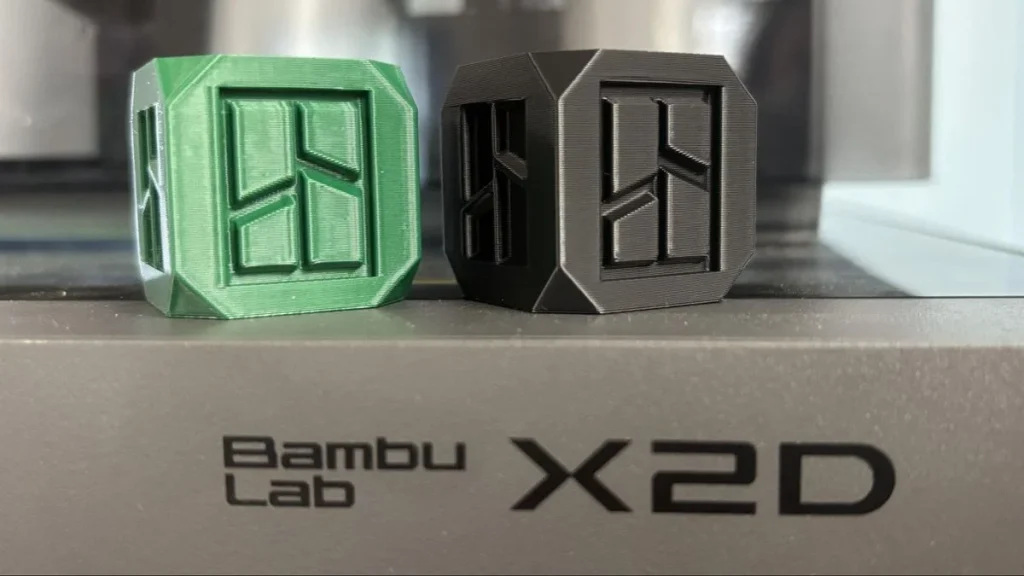
The technology is particularly well-suited for FDM printing with multi-material capabilities. Printers like the Bambu Lab X2D, with its dual-extrusion system, can alternate between conductive and standard filaments in a single print job — making MetaSense-style objects accessible to consumer-grade equipment.
The Bigger Picture: Objects as Interfaces
MetaSense is part of a broader trend in additive manufacturing: moving beyond static shapes toward functional, interactive objects. Earlier this year, researchers demonstrated 3D printed objects that can detect whether they are being used properly, and the European Space Agency is exploring 3D printed metal components for crew autonomy in space. The direction is clear — the objects we print are becoming smarter.
For businesses that specialize in custom manufacturing, this shift creates opportunity. Products that were once passive — a phone case, a toy, a tool handle — can now become interactive interfaces. The competitive advantage goes to manufacturers who can turn these designs into physical products quickly and at scale.
How TT3DPrint Can Help
At TT3DPrint, we specialize in custom FDM 3D printing with a fleet of over 220 Bambu Lab printers. As metamaterial and multi-material printing technologies mature, we are positioned to help designers, engineers, and creators bring smart, interactive objects from concept to production. Whether you need a one-off prototype of a custom input device or a batch of sensor-enabled educational tools, we can deliver. Contact us for a quote and let us help you build the next generation of intelligent products.
Conclusion
MIT’s MetaSense demonstrates that 3D printing is no longer just about shape — it is about function. By embedding sensing directly into the material structure, researchers have eliminated the gap between prototyping and producing interactive devices. For the custom manufacturing industry, this is not a distant lab curiosity. With multi-material FDM printers becoming more capable and accessible, the era of smart, custom-printed objects is arriving now.
Sources: SciTechDaily, IEEE Spectrum