How AI Is Revolutionizing 3D Print Reverse Engineering: From Photos to Printable Parts
AI Is Revolutionizing 3D Printing — Starting With Reverse Engineering
The additive manufacturing industry has long faced a stubborn bottleneck: what happens when you need to 3D print a part, but no CAD model exists? Whether it’s a legacy aerospace component, a discontinued machine part, or a custom replacement for injection-molded hardware, the traditional workflow involves expensive 3D scanners, manual reconstruction, and weeks of engineering time.
A Dayton, Ohio-based startup called Novineer is changing that equation with an AI-powered platform that can generate editable CAD models from a handful of smartphone photographs — in approximately two minutes.
From Photos to Printable Parts: The Novineer Platform
Novineer’s platform consists of three integrated tools that cover the full workflow from reverse engineering through performance simulation to generative design for additive manufacturing:
NoviVision: AI-Powered 3D Reconstruction
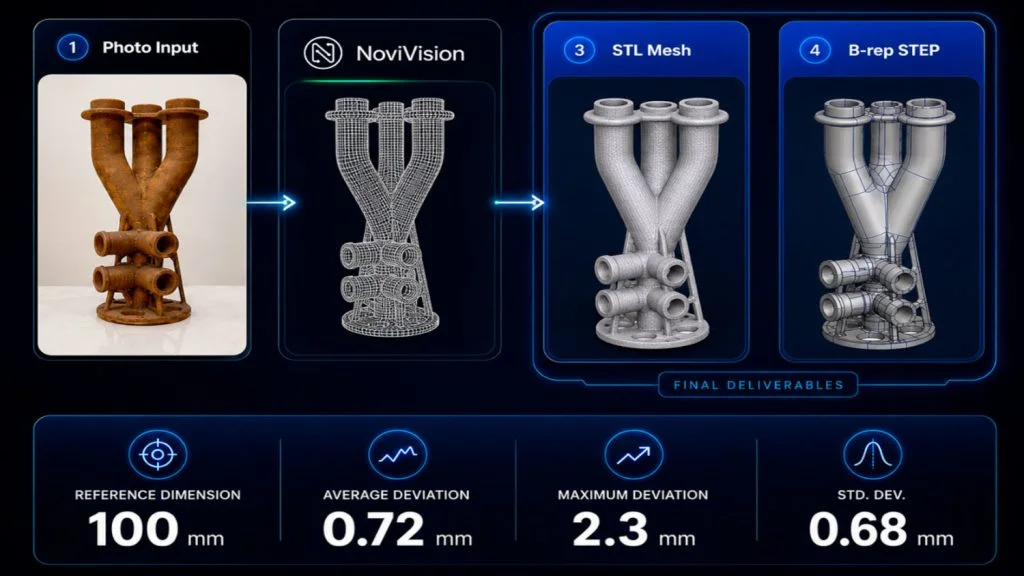
NoviVision replaces specialist hardware and manual reconstruction by using large language models to process 4-5 smartphone photographs into an editable 3D CAD model. The system achieves accuracy levels of 95-97%, with an average error margin of about 3%. While this precision isn’t suitable for CNC machining, it’s more than adequate for FDM and SLS 3D printing applications.
“The problem users want to solve is what to do when a CAD model is missing,” explains Novineer CEO Ali Tamijani. “The LLM helps us get from four or five pictures to a model.”
NoviPath: Toolpath-Aware Simulation
What sets Novineer apart from generic simulation tools is NoviPath, a polymer performance simulation solution that predicts stiffness, strength, and failure in additively manufactured parts before printing. Unlike conventional FEA tools that treat printed parts as uniform solids, NoviPath uses actual toolpath data to account for the layer-by-layer nature of material extrusion.
This is a critical distinction. FDM parts are inherently anisotropic — their mechanical properties differ depending on print orientation and toolpath strategy. NoviPath leverages this reality rather than ignoring it, giving engineers more accurate predictions of how parts will actually perform.
The tool is integrated with Stratasys’ GrabCAD Print Pro as part of a strategic partnership, providing in-depth material property data for well-known FDM materials.
NoviDesign: Generative Design for AM
NoviDesign completes the suite with generative design capability, producing optimized, editable, manufacturable CAD models. The system excels in both stiffness-based and strength-based optimization, utilizing Tsai-Wu failure criteria and designing material orientation from the start for anisotropic properties.
A Real-World Case: Aviation Parts on a Budget
The platform’s impact is best illustrated through a real application. A major airline needed to replace a specific seat arm part on its aircraft. The traditional process would require:
- Sending engineers with 3D scanners to a hangar to disassemble and scan the part
- Manual CAD reconstruction and FEA simulation
- Multiple 3D printing test iterations
- Third-party certification
This process typically takes three weeks and costs between $15,000 and $20,000.
With Novineer, airline staff can simply share pictures and basic reference data with the contract manufacturer. NoviVision creates the 3D model, NoviPath runs simulations using known material properties, and the manufacturer can quickly generate a quote — eliminating travel, scanner rental, and weeks of engineering time.
“Does our approach replace physical testing? No,” Tamijani clarifies. “But not every iteration in your design process needs testing. You can wait until the end.”
Why This Matters for Custom 3D Printing Services
While Novineer’s platform targets aerospace and defense applications, the underlying technology has implications for the entire custom 3D printing industry. The ability to go from photographs to printable files — with built-in material simulation — lowers the barrier for contract manufacturers to take on reverse engineering projects.
For FDM service providers like TT3DPrint, this technology ecosystem creates new opportunities:
- Faster quoting: Generate accurate cost estimates from photos alone
- Broader applications: Take on projects that previously required expensive scanning equipment
- Quality assurance: Use toolpath-aware simulation to predict print success before committing material
- Material optimization: Leverage anisotropic design for stronger, lighter parts
The Bigger Picture: AI Meets Manufacturing
Novineer’s approach reflects a broader trend in manufacturing: AI isn’t replacing engineering expertise — it’s augmenting it. The platform doesn’t eliminate the need for engineers; it removes friction from the early stages of the workflow, letting professionals focus on higher-value tasks like design optimization and quality validation.
As Tamijani puts it: “AI is helping in specific things that we are doing, but it is not really replacing that engineering mindset or the physics.”
With cloud-based high-performance computing and support for private server deployment (critical for aerospace and defense applications), Novineer is positioning itself at the intersection of AI accessibility and industrial-grade manufacturing requirements.
How TT3DPrint Can Help
At TT3DPrint, we specialize in custom FDM 3D printing with a fleet of 220+ Bambu Lab printers. Whether you need to reverse-engineer a legacy part, prototype a new design, or produce batches of custom components, our team delivers worldwide with fast turnaround and competitive pricing.
As AI-driven tools like Novineer make reverse engineering more accessible, we’re ready to help you bring those designs to life with high-quality FDM printing in PLA, PETG, ABS, TPU, and engineering-grade materials.
Contact us today for a quote on your next custom 3D printing project.
Conclusion
The combination of AI-powered reverse engineering, toolpath-aware simulation, and generative design is making additive manufacturing more accessible and cost-effective. As these tools mature, expect to see faster adoption of 3D printing for replacement parts, custom components, and low-volume production runs across industries from aerospace to consumer products.
Sources: DEVELOP3D, Novineer Inc.