Bambu Lab Teases the S1, Its First 3D Scanner, Launching November 2026

Introduction
Bambu Lab has built its reputation on desktop 3D printers that are fast, affordable, and remarkably easy to use. Now the company is pointing at a new category: on October 13, 2026 it put up an official landing page for the Bambu Lab S1, described as its first 3D scanner, with a launch window set for November 2026. The teaser page carries the slogan “Easy in Hand. Pro in Every Scan.” and invites visitors to register their interest, but Bambu Lab has held back pricing and full specifications for the official reveal.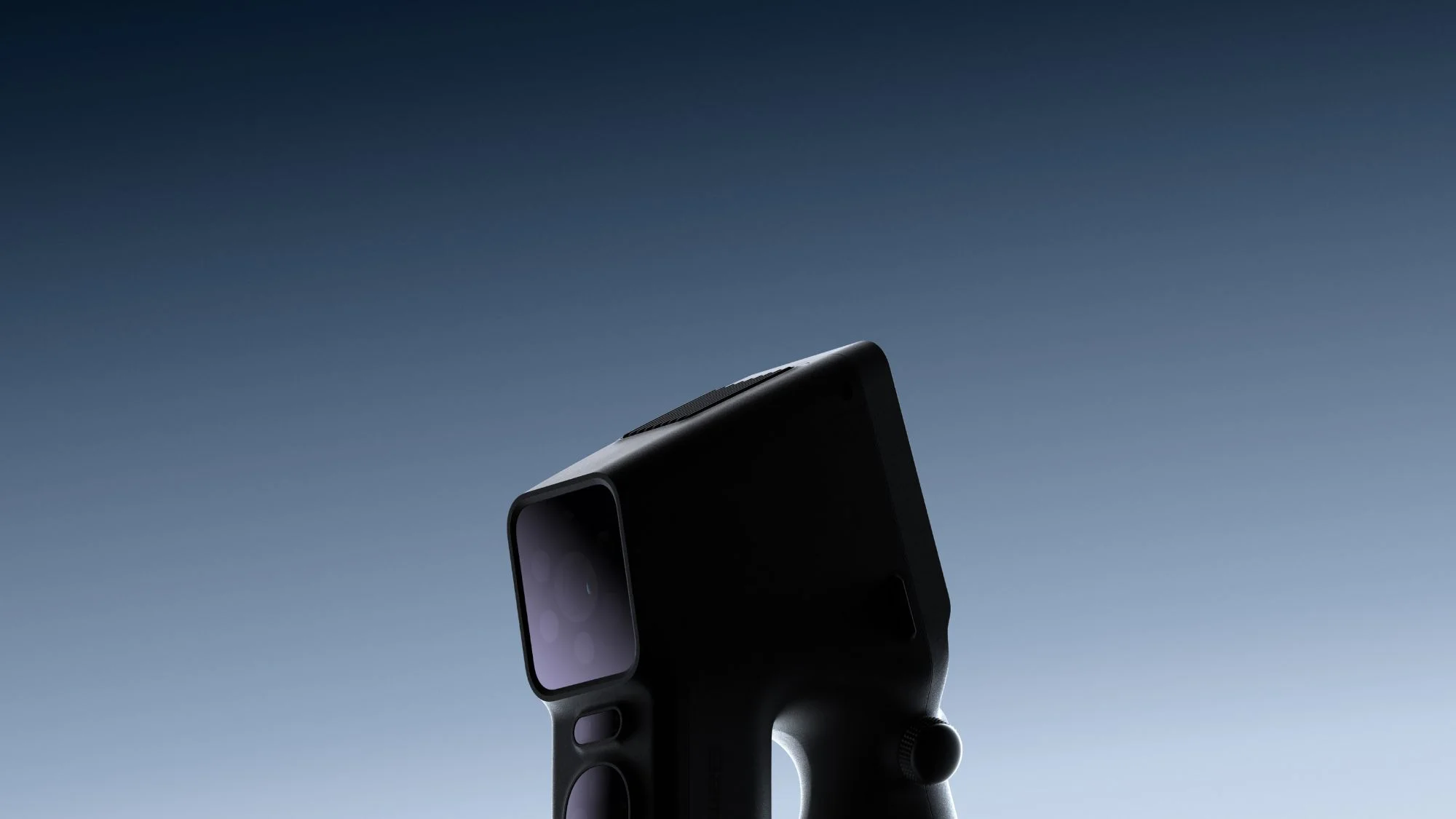
What the Teaser Shows
The teaser image published alongside the announcement depicts a matte-black handheld device with a pistol-style grip and what appear to be multiple cameras or optical sensors arranged on its front face — a form factor typical of structured-light and photogrammetry scanners. Bambu Lab’s own messaging positions the S1 as a professional-grade tool with the same low barrier to entry that defined its printers.
In its public statement, the company framed the move as a logical next step: “Following our 3D printers and laser cutter, stepping into 3D scanning is a natural extension of our ongoing vision: building a personal manufacturing hub by making professional-grade tools accessible. With the S1, we are once again doing what we do best: rigorous engineering craft, professional performance, and an intuitive user experience that lowers the barrier to entry.”
What the FCC Filing Reveals
Before the teaser, the S1 had already surfaced in regulatory paperwork. The device was registered with the FCC under ID 2A6J8-DS001 by Shenzhen Tuozhu Technology Co., Ltd., the company behind the Bambu Lab brand, and received approval from SGS North America on September 22, 2026, with testing carried out by SGS Tongfang in Suzhou, China.
The filing confirms several concrete details:
- Power: a nameplate rating of 20 V at 3 A — 60 W — with no battery listed, which points to a tethered device that depends on an external PC or laptop for processing.
- Wireless: 5 GHz Wi-Fi (5180–5240 MHz and 5745–5825 MHz) with 20, 40, and 80 MHz channel support, approved for indoor use only.
- Portability: specific absorption rate measurements for hands and limbs peaked at 3.81 W/kg, and the documentation includes a housing drawing with a molded grip — both consistent with a handheld product.
- Not yet known: resolution, accuracy, sensor type, price, and exact release date are still absent from the public record.
Tom’s Hardware noted that the chassis drawings bear a resemblance to SCANOLOGY’s 3DeVOK MT Gen2 platform, though that scanner officially sells for $8,299 — a price that would sit awkwardly with Bambu Lab’s consumer-friendly positioning, so a shared platform remains speculative at best.
Why a Scanner Fits Bambu Lab’s Ecosystem
A 3D printer turns digital files into physical objects; a scanner closes the loop in the other direction. With the S1, a user could digitize an existing part, edit it in Bambu Studio, and print a replacement — no CAD expertise required. Industry observers expect scans from the device to plug directly into Bambu Studio and Bambu Suite, making the scan-to-print workflow as painless as the print workflow already is.
That matters for the kinds of jobs 3D printing is increasingly used for: capturing a broken bracket and reprinting it, replicating a hand-made figurine for a small production run, reverse-engineering a custom enclosure, or turning a clay maquette into a printable master. For makers, educators, and small product teams, removing the modeling step is often the difference between an idea that gets made and one that stays on the shelf.
What Happens Next
Bambu Lab has scheduled the S1 announcement for November 2026, when the company is expected to disclose pricing, accuracy figures, and the full sensor configuration. Anyone who wants to be notified at launch can register on the official S1 page. If Bambu Lab repeats the value proposition it delivered with the A1 and P1S lines, the S1 could put a capable handheld scanner in the sub-$1,000 conversation and pull 3D scanning firmly into the desktop maker toolkit.
How TT3DPrint Can Help
You do not need to own a scanner to benefit from scan-to-print workflows. At TT3DPrint, we turn physical objects, reference samples, and supplied scan data into finished FDM prints — figurines, replacement parts, architectural models, teaching aids, and custom prototypes — using a 220-machine Bambu Lab fleet. Send us an object photo, an STL, or a scan file and we will handle cleanup, printing, and worldwide shipping. Explore our capabilities on the products page, or request a quote directly.
Conclusion
The Bambu Lab S1 marks the company’s third product category in as many years and signals that 3D scanning is about to get the same usability treatment that reshaped desktop 3D printing. With the FCC filing complete and the launch event set for November 2026, we will know soon whether the S1 delivers pro-level scans at a maker-level price. Watch this space — and if you already have an object you would like turned into a physical part, get in touch today.