Creality IPO: What It Means for the Future of Consumer 3D Printing
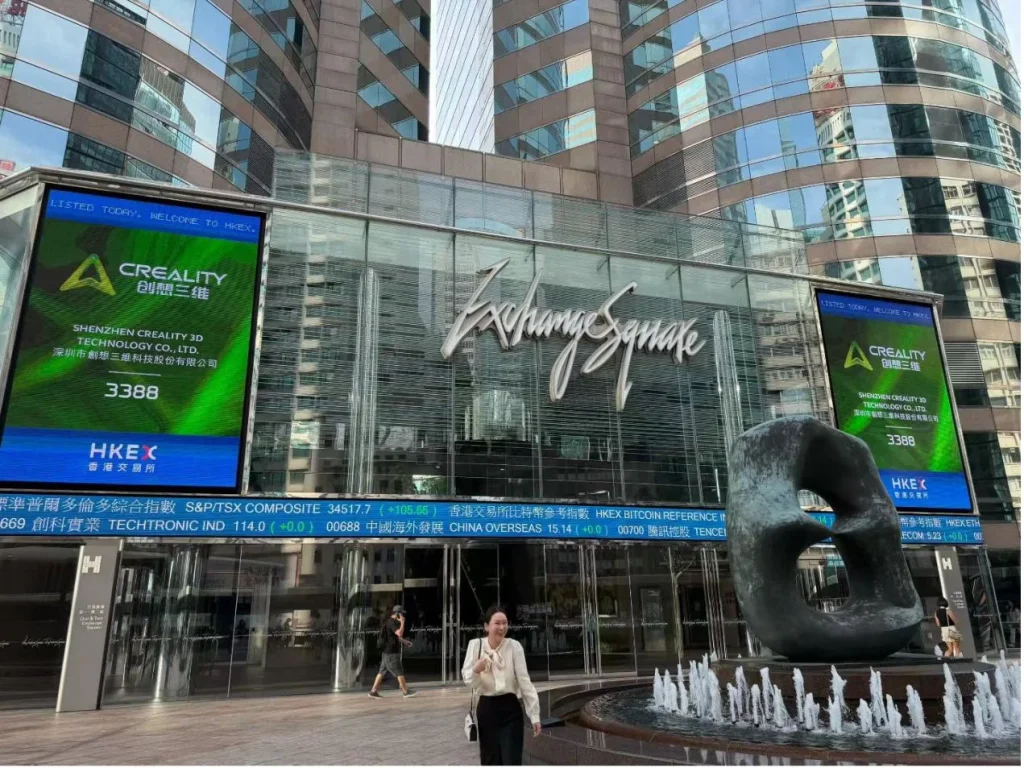
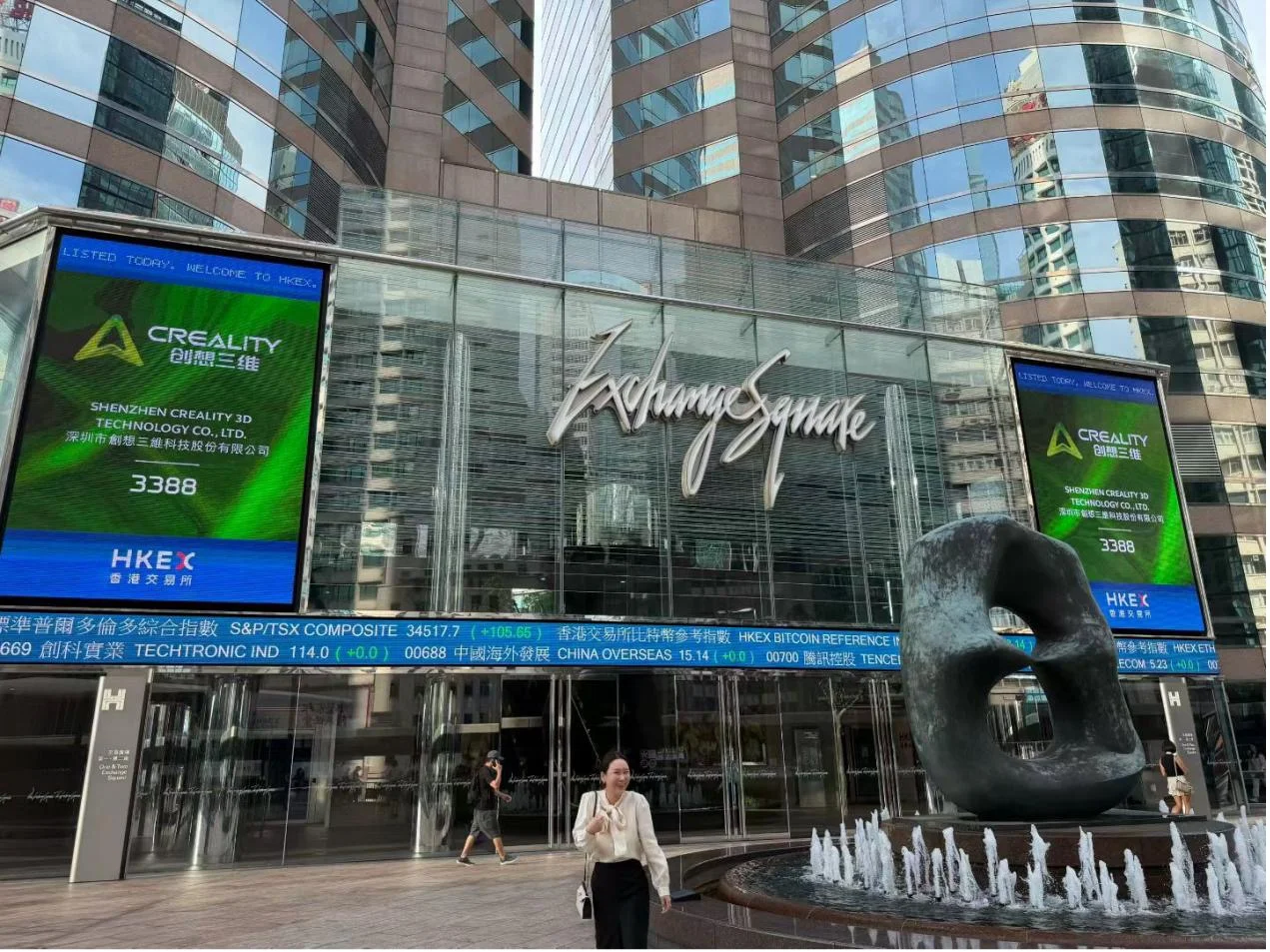
The bell has rung at the Hong Kong Stock Exchange (HKEX) for Creality, and the consumer 3D printing world is watching closely. Opening at HK$33.80 per share — up from an IPO price of HK$18.80 — Creality’s listing valued the company at nearly HK$16 billion, with the Hong Kong public offering oversubscribed an astonishing 3,829 times.
For many, this is “just another 3D printing company going public.” But a deeper look at the prospectus, industry data, and global market trends reveals something far more significant: China’s consumer 3D printing industry has entered a fundamentally new phase of global competition.
Creality’s Market Position: Strength Beneath the Surface
Creality holds an undisputed dominant position in the global consumer 3D printing market. In 2025, its printer gross merchandise value (GMV) ranked second globally with an 11.2% share, while its scanner GMV topped the market at 45.3%. The company’s laser engraver business also ranked among the top four categories globally.
The numbers tell a story of impressive global reach. Creality now operates in more than 140 countries and regions, with the US market alone contributing nearly 30% of revenue. North America and Europe together account for over 57% of total sales — a presence built not through OEM manufacturing alone, but through a sophisticated distribution and brand strategy.
Behind this growth sits a formidable supply chain. Three major production bases in Wuhan, Huizhou, and Shenzhen span more than 260,000 square meters, exemplifying the classic “Shenzhen model” of extreme cost control and rapid iteration.
The Platform Play: More Than Just Hardware
Perhaps the most important part of Creality’s long-term strategy is its evolution from a hardware company to a platform company. Creality Cloud has over 5.7 million registered users, and the company is embedding AI across its product lineup — from text-to-3D modeling to AI-assisted leveling, flow calibration, and fault detection during printing.
The company’s response to the competitive landscape appears clear: first, product premiumization through the K2 series; second, platform ecosystem development; and third, deepening AI integration across the product stack.
The Profitability Challenge
Beneath the glossy IPO numbers lie several signals worth examining. Revenue grew strongly from RMB 1.88 billion in 2023 to RMB 3.13 billion in 2025. However, operating profit fell from RMB 177 million in 2023 to an operating loss, creating a “revenue without profit” scissors gap.
Where did the money go? Two places: sales and marketing (expense ratio jumped from 16.0% to 18.2%), and R&D (nearly doubled in absolute terms from RMB 96 million to RMB 223 million). The sales spending went mostly toward Amazon promotions and overseas KOL marketing — a necessary but expensive strategy in an increasingly competitive market.
Operating cash flow in 2025 was negative RMB 63.98 million, a figure that stands out in the filing. The company stocked up on inventory to prepare for US tariffs and intensifying competition — a classic “exchanging cash flow for market share” strategy that becomes riskier under public company scrutiny.
The Bambu Lab Factor: Apple vs Android
The prospectus reveals a critical competitive dynamic. The filing states that the largest market participant holds more than 40% market share, while the remaining top five each hold about 10%. That “largest participant” is widely understood to be Bambu Lab.
Creality’s own global printer GMV share fell from 15.4% in 2023 to 11.2% in 2025. The share that was lost has largely gone to Bambu Lab, which has captured the market through what can be described as an “Apple-style play” — defining the industry ceiling with one or two exceptional products, locking in core users through the MakerWorld ecosystem, and building premium brand loyalty.
Creality, by contrast, follows more of an “Android-style play” — a broad product matrix and deep distribution network covering every price segment. The question is whether “width” can withstand “sharpness” as more users are drawn to Bambu Lab’s foolproof user experience.
The Tariff Tightrope
Nearly 30% of Creality’s revenue comes from the United States, a market currently facing combined tariffs of roughly 40% to 50%. This significantly erodes price competitiveness. The company is exploring manufacturing in Vietnam, but shifting production away from China’s highly optimized supply chain is neither quick nor cheap.
Any major volatility in the US market — whether from additional tariffs, trade restrictions, or anti-dumping investigations — could materially affect Creality’s revenue and profitability.
What This Means for the 3D Printing Industry
Creality’s IPO is not just a financial event — it’s a signal that the consumer 3D printing market is maturing into a serious global industry. The fact that a Chinese 3D printing company can raise nearly HK$16 billion on the Hong Kong exchange speaks to investor confidence in the sector’s long-term growth potential.
For the broader industry, several trends emerge:
- Market consolidation is accelerating. The gap between the top player (40%+ share) and the rest is widening, creating winner-take-most dynamics.
- AI integration is becoming table stakes. Both Creality and Bambu Lab are embedding AI into every stage of the printing workflow.
- Platform ecosystems matter as much as hardware. Software, community, and content are the new battlegrounds.
- Tariff and trade risks are real. Companies with heavy US exposure face structural headwinds.
How TT3DPrint Can Help
At TT3DPrint, we stay closely attuned to these industry shifts because they directly impact how we serve our customers. As a Bambu Lab-powered custom 3D printing service, we benefit from the same ecosystem advantages that have driven Bambu Lab’s market leadership — reliable multi-color printing, consistent quality, and rapid turnaround.
Whether you need custom figurines, educational models, branded gifts, or prototype parts, our Bambu Lab cluster delivers the precision and speed that today’s competitive market demands. We handle orders of all sizes, from single custom pieces to批量 production runs, with worldwide shipping via DHL, FedEx, and UPS.
Ready to bring your ideas to life? Contact us today for a free quote.
Conclusion
Creality’s IPO marks a milestone for the consumer 3D printing industry, but the real story is what comes next. The competition between Creality’s broad-market approach and Bambu Lab’s premium ecosystem play will define the industry’s trajectory for years to come. For businesses and creators who rely on 3D printing, this increased competition means better products, more innovation, and more choices — exactly the kind of environment where custom printing services like TT3DPrint thrive.