Caltech Uses 3D Printing to Rethink the Lithium-Ion Battery
A New Way to Think About Battery Design
Lithium-ion batteries have powered everything from smartphones to electric vehicles for over two decades. But they still carry safety risks, rely on expensive and ethically questionable materials, and are approaching the limits of conventional design. Now, researchers at the California Institute of Technology (Caltech) believe the answer lies not in inventing a new battery chemistry, but in reimagining how we build the one we already have — using 3D printing.
Julia R. Greer, the Ruben F. and Donna Mettler Professor of Materials Science, Mechanics and Medical Engineering at Caltech, and her team have developed a cobalt-free lithium-ion battery cathode built with a complex three-dimensional architecture. The findings, published in ACS Energy Letters on June 23, 2026, demonstrate that reshaping existing battery materials through additive manufacturing can fundamentally change how batteries perform.
From Flat to 3D: Why Electrode Shape Matters
Today’s lithium-ion battery electrodes are essentially flat, two-dimensional layers. This design is straightforward to manufacture, but it limits how efficiently lithium ions can move between the anode and cathode during charging and discharging.
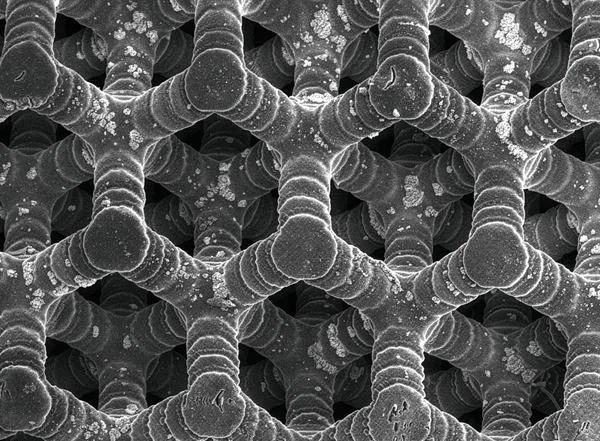
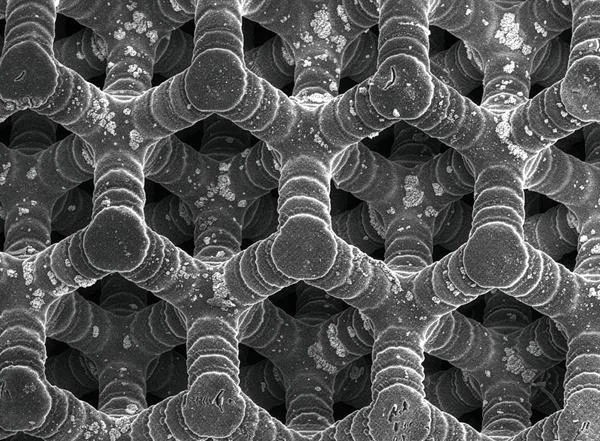
The Caltech team replaced this flat design with a three-dimensional micro-architecture. Instead of ions traveling through a single flat plane, they move through a carefully engineered labyrinth of channels and surfaces. According to Greer, this approach provides a crucial advantage: “If you make a battery that is 3D architected instead of planar, every lithium ion is going to have an active surface available to it as it’s transporting through the electrolyte.”
These additional surfaces act as pathways for converting chemical energy into electrical energy. By reducing the tortuosity — the distance ions must travel between electrodes — the 3D architecture enables higher power density, meaning the battery can release stored energy faster.
Dropping Cobalt: Safer and More Sustainable
One of the most significant changes is the material choice. The new cathode is made from lithium iron phosphate (LFP) combined with a carbon matrix, eliminating cobalt entirely. Cobalt has been a staple of lithium-ion battery cathodes for years, but its use comes with serious downsides: it is expensive, supply chains are concentrated in regions with documented ethical concerns, and it is difficult to recycle.
LFP offers a much better safety profile. Unlike cobalt-based cathodes, LFP is far less likely to catch fire or short-circuit when overcharged — a critical advantage for consumer electronics and electric vehicles where thermal runaway remains a concern.
“LFP by itself is not a new material, but using this additive manufacturing, or 3D-printing approach to create an architected electrode that doesn’t contain cobalt, is a new thing,” says Greer.
How Hydrogel Infusion Additive Manufacturing Works
The 3D printing technique used is called hydrogel infusion additive manufacturing (HIAM), a process developed in Caltech’s Greer Lab. HIAM builds intricate micro-scale structures by starting with a hydrogel scaffold and infusing it with the target material — in this case, LFP and carbon.
This method allows the creation of structures with features too fine and complex for traditional manufacturing techniques. The resulting electrode is a precise, three-dimensional lattice that optimizes ion transport pathways while maintaining structural integrity.
The research was co-authored by Yuchun Sun (PhD ’24) and supported by the Defense Advanced Research Projects Agency (DARPA) and NASA’s Jet Propulsion Laboratory through its President’s and Director’s Research and Development Fund.
The Road Ahead: Solid-State Batteries
The team’s next goal is to design a complementary 3D-architected LFP anode, which would create a battery with fully three-dimensional electrodes that is both energy-dense and power-dense. Beyond that, Greer envisions combining the architected electrodes with a solid-state electrolyte — a transition that could dramatically improve safety and enable lightweight batteries for applications like spacecraft electrification.
“I’m a big fan of solid-state batteries, and I think that eventually we are all going to transition to the solid-state world,” Greer says. “Our architected electrode is another stepping stone toward enabling solid-state batteries someday.”
Why This Matters for 3D Printing and Manufacturing
This research highlights a growing trend: 3D printing is no longer just for prototyping. It is enabling entirely new approaches to manufacturing that were previously impossible. The ability to create complex, architected materials at the micro-scale opens doors for applications across energy, aerospace, biomedical devices, and beyond.
For the 3D printing industry, studies like this reinforce the technology’s value as a production tool, not just a design tool. As additive manufacturing matures, expect to see more breakthroughs where the shape of a component — enabled only by 3D printing — delivers performance gains that no traditional process can match.
How TT3DPrint Can Help
At TT3DPrint, we specialize in custom FDM 3D printing for prototypes, functional parts, and innovative applications. Whether you are developing new battery components, testing lattice structures, or creating custom enclosures for energy storage systems, our Bambu Lab cluster of 220+ printers delivers precision and speed at scale.
Need a custom 3D print for your research or product development? Contact us for a quote — we ship worldwide.