Prusa ColorMix: Open-Source CMYKW Color Mixing Brings Dozens of Shades to FDM Printing
Introduction: A New Era of Color in FDM 3D Printing
For years, multicolor FDM 3D printing meant one thing: either swap filament manually mid-print or invest in expensive multi-material systems with limited color palettes. That changed on May 26, 2026, when Prusa Research unveiled ColorMix — an open-source color mixing system that lets anyone with a multi-material printer produce dozens of reproducible color tones from just four or five filament spools.
Released under the MIT license and integrated directly into PrusaSlicer 2.9.6 and EasyPrint, ColorMix is not just another slicer feature. It represents a fundamental shift in how desktop 3D printing handles color — one that could reshape everything from custom figurines to product prototyping.
How ColorMix Works: The CMYKW Halftone Model
The technology behind ColorMix draws from a well-established principle in 2D printing: CMYK halftoning. In traditional inkjet printing, cyan, magenta, yellow, and black inks are combined in tiny dots of varying sizes to create continuous color gradients. Prusa adapted this concept for 3D printing with a twist — instead of mixing dots, ColorMix alternates thin layers of differently colored filaments.
Consider a model printed at 0.1mm layer height. If odd layers are white and even layers are black, the human eye perceives grey from a normal viewing distance. The limited resolution of human vision merges the alternating colors into a single perceived tone. ColorMix takes this principle and applies it systematically using five base colors:
- Cyan (C) — Blue-green base
- Magenta (M) — Red-purple base
- Yellow (Y) — Warm base
- Key/Black (K) — Darkness control
- White (W) — Lightness base
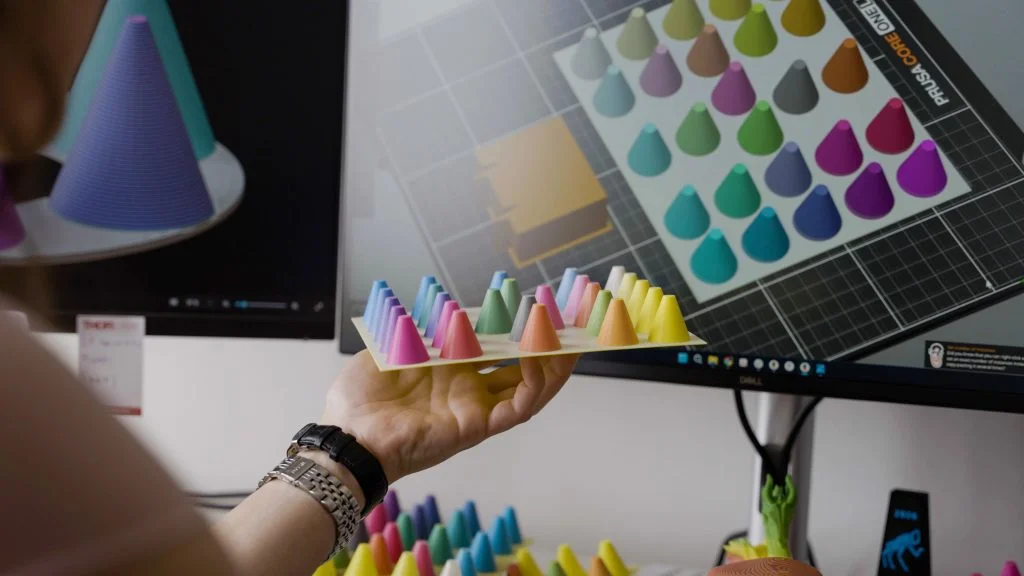
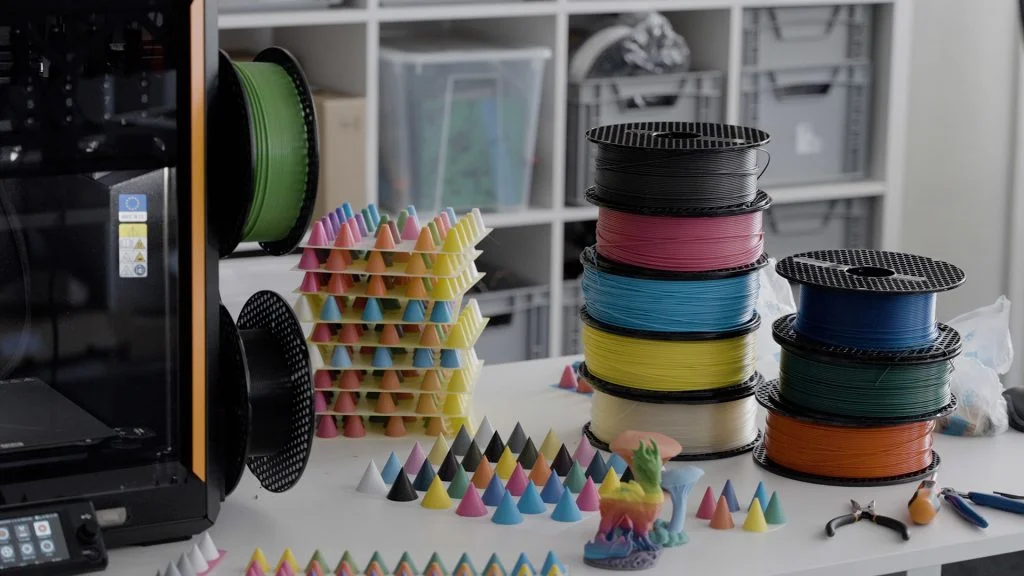
By varying the layer ratios between these five filaments, ColorMix can produce approximately 40 reproducible color combinations — from deep burgundies and teals to soft pastels and earth tones. The system uses calibrated color mixing models rather than rough guesswork, providing more accurate color previews than any previous solution.
From Community Experiment to Production Tool
ColorMix did not emerge in a vacuum. Over the past several months, the 3D printing community had been experimenting with virtual filament mixing in various slicer forks. Projects like Ratdoux’s OrcaSlicer-FullSpectrum demonstrated how alternating layers of different colors could create convincing mixed tones. Justin H. Rahb’s filament-mixer helped predict what those colors might look like, and community tools like PeggyPalette made it easier to compare and share results.
Prusa took these community innovations and formalized them. The teams working on Prusament filaments, PrusaSlicer, EasyPrint, and the OpenPrintTag Material Database collaborated to create a calibrated color mixing model based on measured FDM print results. The result is a workflow that makes printing in color feel more like painting than programming.
Why This Matters for Custom 3D Printing
The implications of ColorMix extend far beyond hobbyist experimentation. For businesses that specialize in custom 3D printed products — figurines, educational models, prototypes, and creative gifts — this technology solves a long-standing problem: achieving rich color variety without maintaining dozens of filament spools.
Consider the economics. A typical multi-color 3D printing setup might require 10-20 different filament colors to achieve reasonable variety. With ColorMix, the same range of tones can be achieved with just 4-5 spools of CMYKW filaments. For a small workshop or a custom printing service, this means:
- Lower inventory costs — fewer filament spools to stock and manage
- Wider color range — more tones available from fewer materials
- Consistent results — calibrated models replace trial-and-error
- Accurate previews — see the color before you print
For custom figurine production, where each piece might require a unique color palette, ColorMix eliminates the need to pre-purchase every possible shade. A workshop can stock five CMYKW spools and produce virtually any color tone a customer requests.
Open Source and Printer-Agnostic
One of the most significant aspects of ColorMix is that it is printer-agnostic. While developed by Prusa for PrusaSlicer and EasyPrint, the CMYKW halftone model works with any multi-material FDM printer that supports layer-by-layer color changes. The open-source MIT license means the community can inspect, improve, and adapt the technology for other slicers and platforms.
This openness also extends to the color data. ColorMix integrates with the OpenPrintTag Material Database, which provides calibrated material properties for accurate color prediction. As more filaments are added to the database, the system’s color accuracy improves for everyone.
Complementary Tools: Studio Lighting and Web Apps
Alongside ColorMix, Prusa released a free web application that adds another dimension to multicolor printing: simulated studio lighting. This tool lets users apply realistic lighting effects to their 3D models before printing, creating the illusion of directional light, shadows, and highlights through color gradients alone.
For custom figurine makers, this means prints that look professionally lit right off the build plate — without post-processing or painting. The combination of ColorMix color mixing and studio lighting effects opens new creative possibilities for anyone producing display-quality 3D prints.
The Future of Color in Desktop 3D Printing
ColorMix represents a broader trend in the 3D printing industry: the democratization of capabilities that were previously reserved for industrial systems. What used to require tens of thousands of dollars in equipment and specialized expertise is now accessible to anyone with a multi-material desktop printer and four rolls of filament.
As the technology matures and more material data becomes available through the OpenPrintTag database, we can expect the color accuracy and variety to improve further. For custom 3D printing services, this means an expanding palette of possibilities — and a compelling reason for customers to choose 3D printed products over traditional manufacturing for colorful,定制 applications.
How TT3DPrint Can Help
At TT3DPrint, we stay at the forefront of 3D printing technology to deliver the best possible results for our customers. Our Bambu Lab printer cluster already supports multicolor printing, and innovations like Prusa’s ColorMix demonstrate the rapid advancement of color capabilities in FDM printing.
Whether you need custom figurines with specific color schemes, educational models with accurate color coding, or prototypes that match your brand colors, our team combines cutting-edge technology with years of printing expertise. Contact us today to discuss your custom 3D printing project.
Conclusion
Prusa’s ColorMix is more than a slicer update — it is a paradigm shift in how desktop 3D printing handles color. By making dozens of reproducible colors available from just a handful of filaments, and by releasing the technology as open source, Prusa has lowered the barrier to multicolor printing for makers, businesses, and custom printing services worldwide.
The era of limited-color FDM printing is ending. With tools like ColorMix, the future of desktop 3D printing is not just functional — it is vibrant.