3D-Printed Swallowable Robot Could Replace Invasive GI Procedures
A Swallowable Robot Powered by 3D Printing
What if a patient could simply swallow a small capsule — and have it navigate through their stomach, take photos, deliver drugs, or even collect tissue samples — all without surgery? That’s exactly what researchers at the University of Texas at Austin are working on. Their MINIMAX lab has developed a 3D-printable, magnetically steerable capsule robot that could fundamentally change how we diagnose and treat gastrointestinal (GI) conditions.
Published as a preprint on arXiv in February 2026, the research introduces a soft capsule robot coated with a 3D-printed magnetic layer that allows it to be steered through the GI tract using external magnetic fields. Unlike traditional capsule endoscopes that passively travel through the digestive system, this new design can be actively controlled — rolling, turning, and even climbing small inclines inside the body.
The Problem with Traditional Endoscopy
Endoscopic procedures like ERCP (Endoscopic Retrograde Cholangiopancreatography) are essential tools for diagnosing and treating conditions in the gastrointestinal tract. But they come with significant downsides: throat irritation, patient discomfort, procedural burden, and the need for sedation. For patients who require repeated procedures — like those with gallstone-related complications — the experience can be particularly taxing.
Fangzhou Xia, director of the MINIMAX lab and senior author of the study, experienced this firsthand. In 2022, while a postdoc at MIT, Xia underwent multiple ERCP procedures following gallstone-induced bile duct blockage, complicated by a concurrent COVID infection. The experience inspired him to develop a less invasive alternative.
“Undergoing multiple ERCPs made me acutely aware of how invasive endoscopic procedures can be,” Xia explained. “That personal experience drove me to explore ingestible sensing systems that could reduce the procedural burden on patients.”
How the 3D-Printed Capsule Works
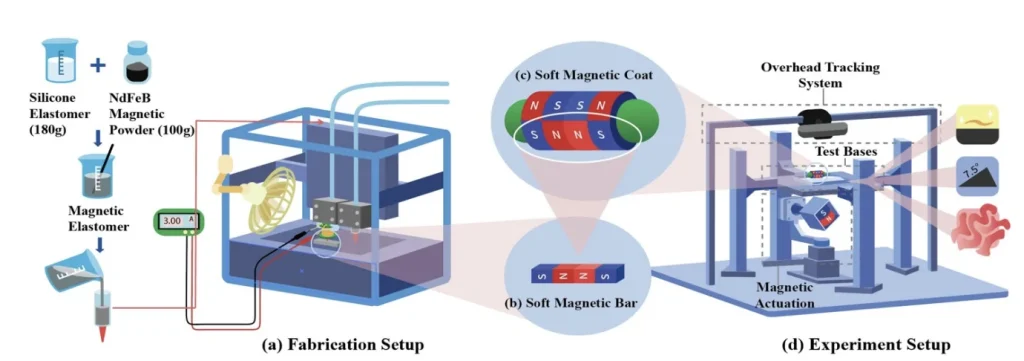
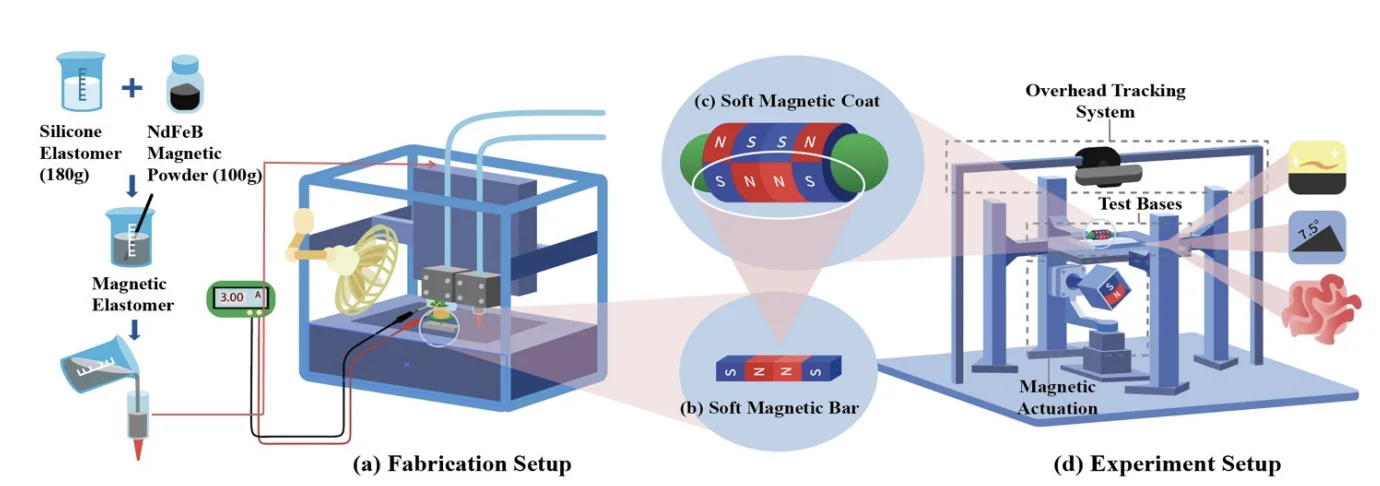
The innovation lies in the capsule’s magnetic coating. Traditional capsule robots embed large permanent magnets inside the device, consuming critical space that could otherwise be used for cameras, sensors, or drug payloads. The UT Austin team took a different approach: they 3D-printed an anisotropic magnetic coating directly onto the capsule’s surface.
The coating is made from a composite of silicone and neodymium iron boron (NdFeB) particles. During the 3D printing process, an integrated coil aligns the magnetic domains in real-time via controlled current, programming the magnetic orientation layer by layer according to G-code. The result is a capsule that can be externally steered using a rotating magnetic field — no internal motors or batteries required.
The system uses two stepper motors to control the external magnetic field: horizontal rotation drives forward rolling, while vertical rotation controls the steering direction. A high-resolution overhead camera tracks the capsule’s position and orientation throughout the procedure.
Tested in Simulated Stomach Environments
The research team validated the capsule across four simulated environments:
- Smooth PLA surface — demonstrated stable bidirectional rolling and precise steering
- Silicone slope — showed the capsule could climb inclines using increased magnetic torque
- Dry simulated stomach — navigated protrusions mimicking gastric folds successfully
- Wet simulated stomach — performed smoothly with fluid present, though occasional slippage occurred on wet surfaces
These results demonstrate that the capsule can handle the kind of varied terrain it would encounter in a real GI tract, from smooth intestinal walls to the textured surface of the stomach lining.
Why 3D Printing Makes This Possible
The use of 3D printing is what makes this approach both innovative and accessible. By fabricating the magnetic coating directly onto the capsule, the team eliminates the need for complex microfabrication facilities. The design can be produced on consumer and prosumer FDM or resin printers — the same kind of machines used by makers and hobbyists worldwide.
This democratization of medical device fabrication is significant. It means university labs and research groups can prototype ingestible robots without investing in specialized manufacturing equipment. Rapid iteration becomes possible: design a new coating pattern, print it, test it, and refine — all within days rather than months.
The approach also aligns with a broader trend in medical 3D printing, where additive manufacturing is increasingly used for patient-specific implants, surgical guides, and now — robotic medical devices. From titanium pelvic implants at Cleveland Clinic to magnetically actuated micro-robots at ETH Zurich, 3D printing is reshaping what’s possible in healthcare.
What’s Next for the Technology
While the current results are promising, the team acknowledges several challenges that need to be addressed before clinical use:
- Real-world complexity: Laboratory conditions don’t fully replicate the mucus, fluid dynamics, and unpredictable terrain of a living GI tract
- Control precision: Steering accuracy depends on precise alignment of the external magnet; lateral offsets reduce control fidelity
- Material optimization: The coating composition, thickness, and magnetic layout need further refinement for durability and force output
Future work will focus on integrating sensors for real-time navigation feedback, developing closed-loop control systems (potentially using robotic-arm-driven magnets), and advancing toward clinical applications in drug delivery, endoscopy, and biopsy.
The team’s long-term vision extends beyond the stomach. They aim to develop a “body-area-network” of ingestible and implantable sensing systems — a network of tiny devices inside the body that communicate health data in real-time.
How TT3DPrint Can Help
The UT Austin capsule robot is a powerful example of how 3D printing is pushing the boundaries of what’s possible in medical technology. At TT3DPrint, we specialize in custom FDM 3D printing for prototypes, medical models, and specialized components. Whether you’re developing a new medical device, need functional prototypes for testing, or require custom-printed parts for research applications, our Bambu Lab printing cluster delivers precision and reliability at scale.
We work with researchers, engineers, and innovators worldwide — providing fast turnaround on custom 3D printed projects from single prototypes to small-batch production. If you’re exploring new applications for 3D printing in healthcare or any other field, contact us to discuss how we can bring your designs to life.
Conclusion
The 3D-printed swallowable capsule robot from UT Austin represents a compelling intersection of additive manufacturing and medical robotics. By using 3D printing to create a magnetic coating that preserves internal space for cameras and sensors, the team has opened a new path toward less invasive gastrointestinal diagnostics. As the technology matures — with improved materials, smarter controls, and real-world validation — ingestible robots could become a routine part of medical care, reducing patient discomfort and expanding what doctors can see and treat inside the human body.
Sources: arXiv Preprint (2602.10688) · 3D Printing Industry · VoxelMatters