
Prusa HT Hotend Brings 400°C Printing to the CORE One
Introduction
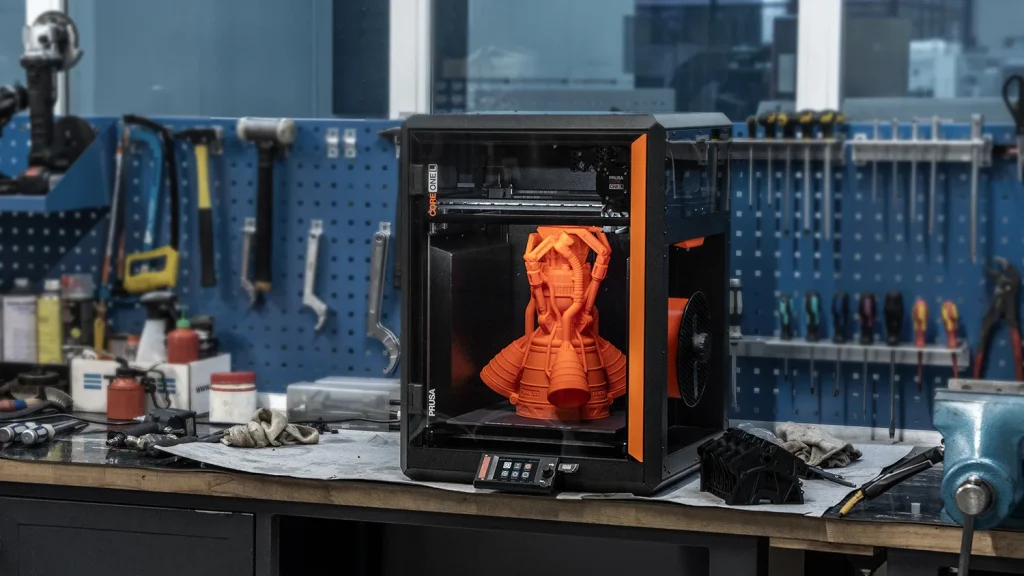
Prusa Research has released two high-temperature products aimed at owners of its enclosed CORE One printer family: the HT Hotend Upgrade, a tool-less swappable hotend rated for nozzle temperatures up to 400 °C, and a CORE One L+ configuration that ships with that hotend already installed. The upgrade went on sale this week at $199.99, while the fully assembled high-temperature L+ configuration is listed at $2,169.00. According to coverage from VoxelMatters, both items are already available to order, and Prusa’s own store shows the hotend in stock.
The timing is not accidental. Prusa spent the summer refreshing its entire printer lineup — the XL+, CORE One L, and CORE One+ (Gen 2) were announced together in August, followed by the INDX tool-changer shipping — and this release pushes the same machines one step further, from capable desktop printers into machines that can process genuinely industrial filament.
One Hotend, Five Printers, Under a Minute
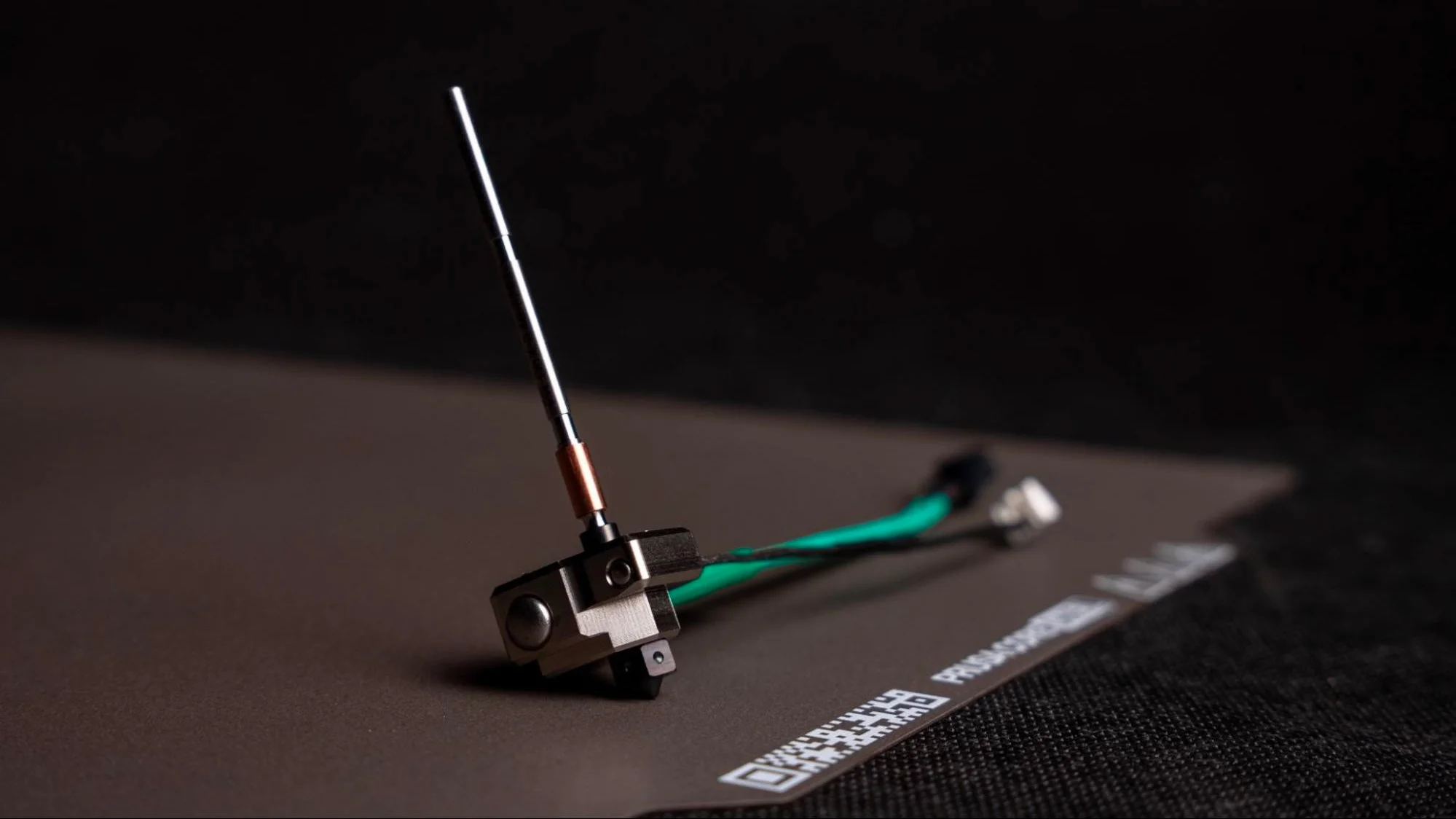
The HT Hotend is compatible with the CORE One, CORE One+, CORE One+ (Gen 2), CORE One L, and CORE One L+. It swaps without tools in less than a minute, so a printer can move between everyday materials and high-temperature work without a lengthy teardown. The kit contains the hotend with a hardened 0.4 mm ObXidian 500 nozzle, two idlers (one for standard materials, one for high-temperature filaments), a main plate printed in PC Blend Carbon Fiber, protective gloves, and a printed guide.
Importantly, Prusa states that PLA, PETG, and other standard materials print normally with the HT Hotend installed, so there is no reason to swap it back for routine jobs. That matters for small shops that run one machine across a mixed workload: the upgrade does not trade away day-to-day flexibility for peak temperature capability.
What 400 °C Actually Unlocks
Higher nozzle temperature is not a vanity spec — it determines which polymers can be printed at all. With the HT Hotend, Prusa lists support for high-performance filaments such as PEKK-CF, PPS-CF, PPS-GF, PPA-CF, and PPSU, materials traditionally associated with industrial machines costing several times as much.
Two of them deserve a closer look:
- PPS (polyphenylene sulfide) — a heat deflection temperature of up to 250 °C, a UL94 V-0 flame-retardant rating, and extreme chemical resistance. Prusa notes that no known solvent dissolves PPS below 200 °C, which makes it attractive for electrical housings, automotive components, and lab equipment.
- PPA Carbon Fiber — a high-performance polyamide with strong resistance to wear, heat, chemicals, and mechanical stress, offering better dimensional stability and lower hygroscopicity than common nylons such as PA6, PA12, and PA612.
The economics are the real story here. Industry-grade filaments are expensive on their own, but Prusa’s argument is that the printer no longer has to be: a $199.99 component turns an existing desktop machine into something that can process them, instead of requiring a five-figure dedicated system.
Measurable Gains on Materials Printers Already Use
The upgrade also improves filaments that CORE One owners are already printing. Prusa reports that printing PA11 Carbon Fiber with the HT Hotend raises interlayer adhesion by 23%, while PC Blend Carbon Fiber printed at 350 °C gains 7% in interlayer adhesion — both directly relevant to parts that see mechanical load. The company also publishes a high-temperature PrusaSlicer profile for ASA to reduce warping and improve overall mechanical properties, and notes better layer strength for ASA generally.
Layer adhesion is the failure point for most FDM parts: prints break between layers long before the bulk material gives way. Anything that measurably improves it makes printed parts more viable as functional end-use components rather than prototypes.
The CORE One L+ High-Temperature Configuration
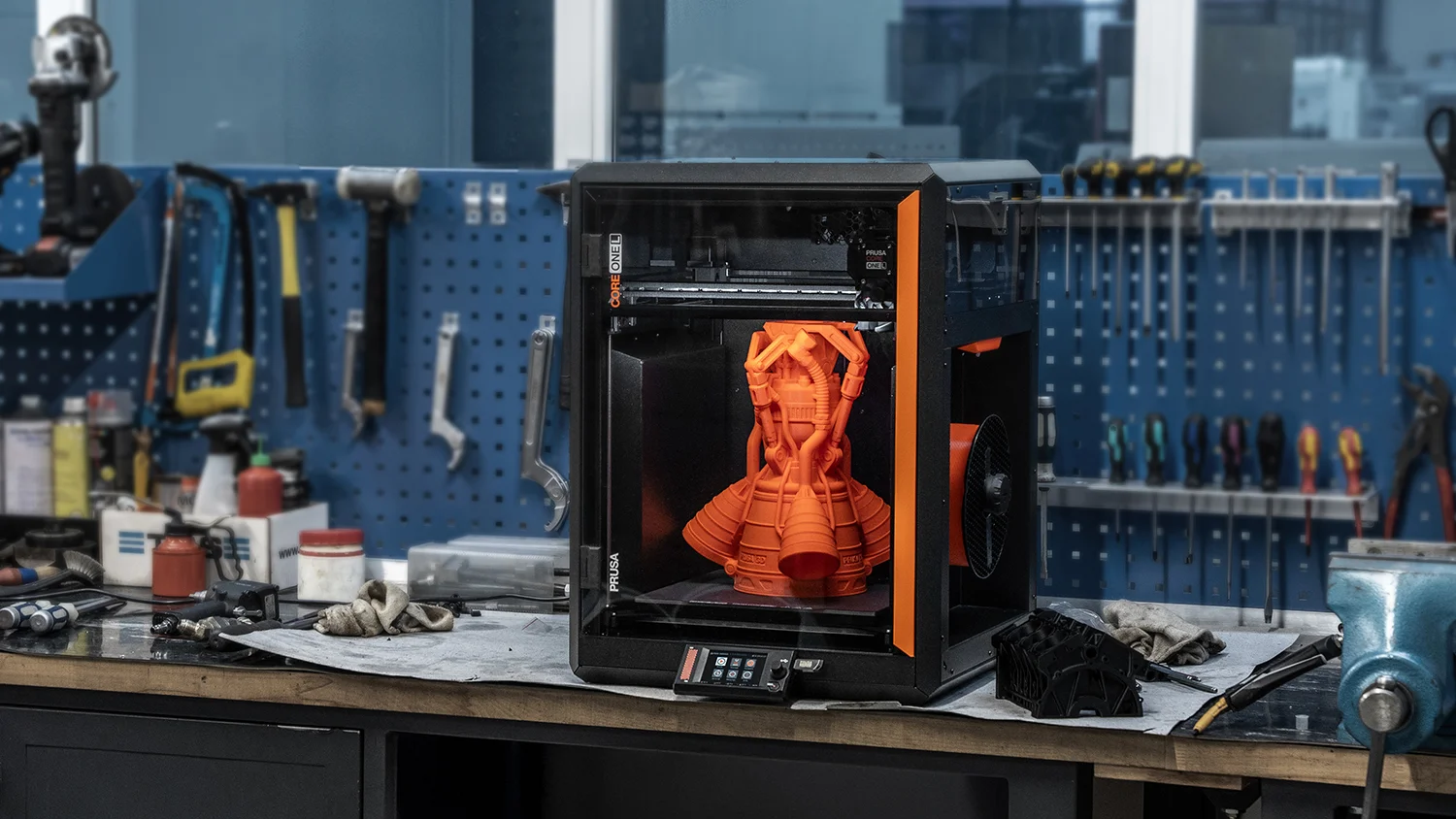
For buyers who want the capability without installing anything, the CORE One L+ arrives with the HT Hotend and an advanced filtration system fitted. It offers a 300 × 300 × 330 mm build volume (29.7 liters) with active convection chamber heating up to 60 °C. By comparison, the more affordable CORE One+ (Gen 2) provides passive chamber heating up to 55 °C and a 250 × 220 × 270 mm build volume, and Prusa’s own comparison table positions it for high-temperature materials at small-part scale only.
Chamber temperature, not just nozzle temperature, is what keeps high-performance polymers from delaminating as they cool — which is why the actively heated L+ is the configuration Prusa recommends for the most demanding materials.
What This Means for Custom Manufacturing
Desktop high-temperature printing narrows a gap that used to force small manufacturers to outsource. Short runs of chemically resistant fixtures, heat-resistant jigs, bracketry, and enclosure parts can now be produced in-house, iterated the same day, and shipped without minimum order quantities. That is precisely the workflow custom print services are built around: send a model, get a quote, approve a sample, receive the batch.
How TT3DPrint Can Help
At TT3DPrint we run a large fleet of enclosed FDM printers for figurines, teaching aids, cultural-creative products, prototypes, and functional parts, and we follow material developments like this closely because they expand what we can offer clients. If you need a part tested in a specific engineering filament, or you want to compare a standard material against a carbon-fiber-filled option before committing to a batch, our team can quote it, print a sample, and ship worldwide through DHL, FedEx, and UPS. Contact us with your model files, or browse our products to see what we print every day.
Conclusion
Prusa’s HT Hotend is a small component with an outsized effect: 400 °C on a desktop machine, tool-less swapping, and access to PPS, PPA, PEKK, and PPSU-class materials for $199.99. Combined with the actively heated CORE One L+, it signals where desktop FDM is heading — not cheaper printers, but more capable ones. Watch this space: as these materials become routine, the line between “prototype” and “production part” keeps getting thinner.
Sources: VoxelMatters — Prusa Research launches two high-temperature products; Prusa Research — HT Hotend Upgrade official product page; All3DP.


