Revopoint POP 4 3D Scanner: Five Modes, One Device, 79
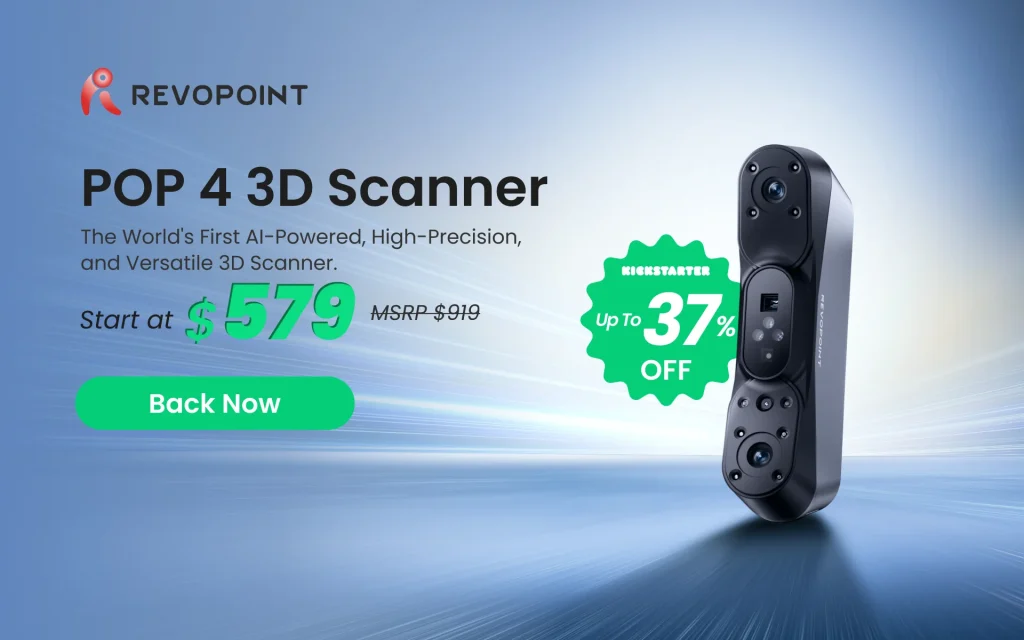
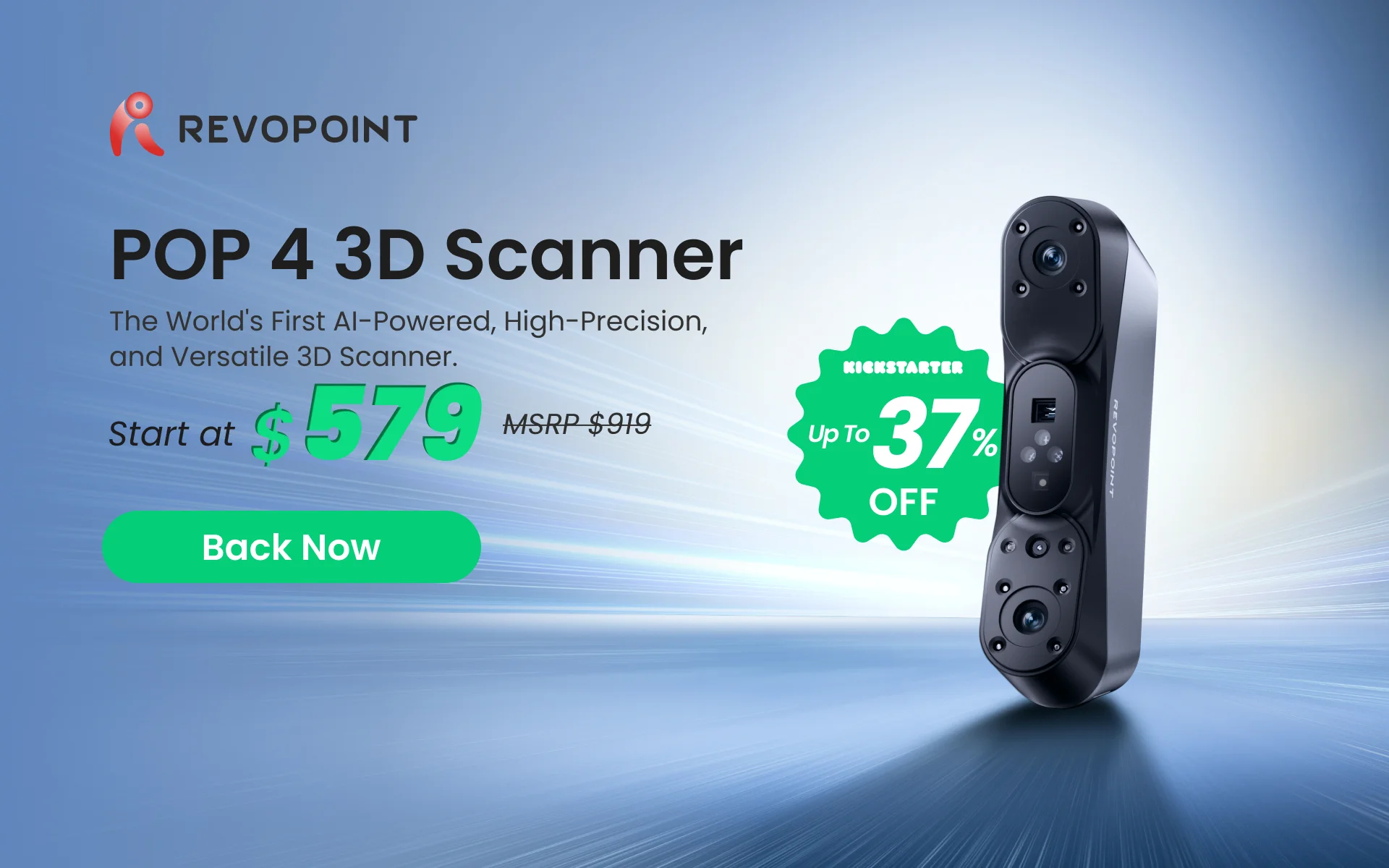
Revopoint POP 4: The First Consumer 3D Scanner That Handles Shiny Metal and Dark Surfaces
3D scanning has long been the missing link in the desktop manufacturing workflow. You can design in CAD, slice in your favorite software, and print on a Bambu Lab or Creality machine — but reverse-engineering a physical object into a printable file has remained frustratingly unreliable for most hobbyists and small businesses. That changes with the Revopoint POP 4, which launched on Kickstarter on May 10, 2026, promising to solve the two problems that have plagued affordable scanners for years: shiny metal and dark surfaces.
Why Previous Scanners Failed on Difficult Surfaces
Most consumer-grade 3D scanners rely on infrared structured light. This technology works well on matte, light-colored objects, but it breaks down quickly when confronted with polished metal (which reflects the projected pattern in unpredictable ways) or dark materials (which absorb the infrared light before the sensor can read it). Blue laser scanners handle these materials better, but they struggle with organic textures, hair, and skin.
The result is that professionals who need to scan automotive parts, industrial components, or mixed-material assemblies often have to buy two separate scanners or resort to expensive industrial equipment costing tens of thousands of dollars.
Five Scanning Modes in One Device
The POP 4 takes a different approach by combining five distinct scanning modes in a single handheld unit:
- Near-infrared structured light (detailed mode) — for high-precision capture of general objects
- Near-infrared structured light (speed mode) — optimized for faster scanning of larger objects
- Dual projector mode — coordinated projectors for fast, high-quality surface capture
- Blue laser 30-crossed-line mode — for high-reflectivity metals and dark materials
- Blue laser single-line mode — for narrow grooves, deep holes, and fine details
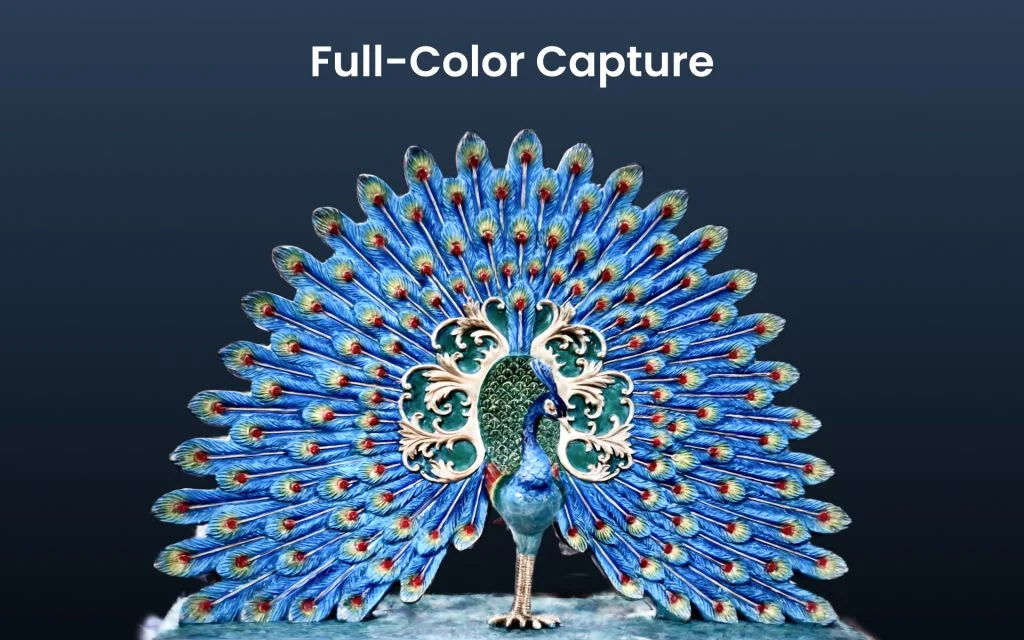
Users switch between modes based on what they’re scanning, not because the scanner forces a compromise. This flexibility is what makes the POP 4 genuinely useful for the kind of mixed-material projects that come up in real workshop environments.
Industrial-Grade Accuracy at a Consumer Price
The technical specifications are impressive for a device in this price range:
- Fused point distance: 0.05 mm
- Volumetric accuracy (laser modes): 0.03 mm + 0.05 mm/m
- Frame rate: 105 fps in multi-line laser mode
- Working distance: 200–800 mm
- Outdoor capability: up to 100,000 lux (direct sunlight)
The outdoor rating is particularly noteworthy. Most structured light scanners are effectively indoor instruments because ambient light competes with the projected pattern. The POP 4’s ability to work in direct sunlight opens up archaeological fieldwork, on-site industrial inspection, and outdoor reverse engineering — applications that previously required equipment costing five to ten times more.
AI-Powered Segmentation and Gaussian Splatting Output
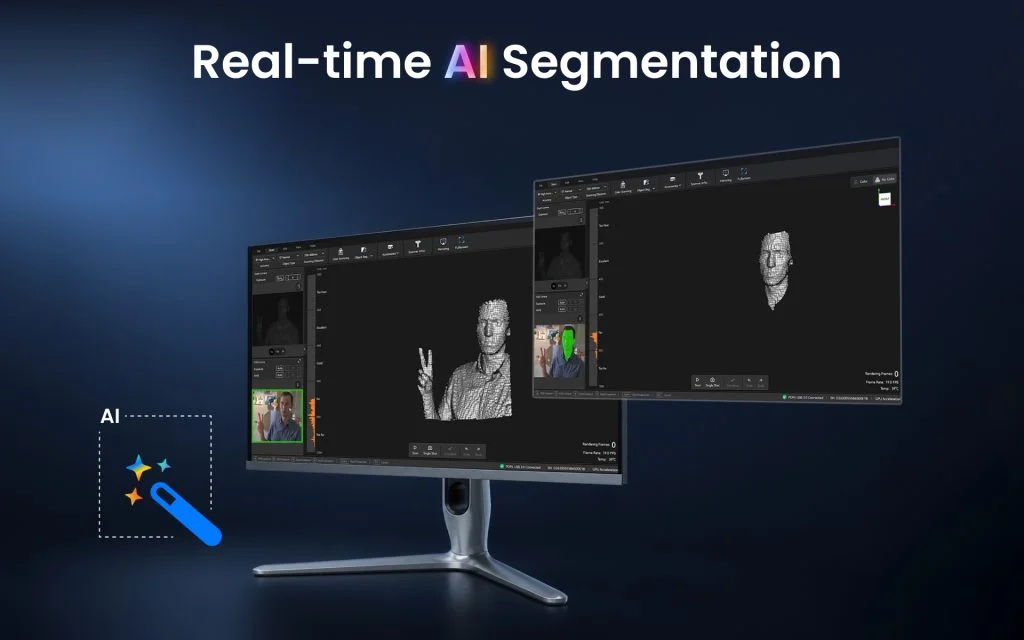
Two software features stand out from the incremental updates we typically see in consumer scanners. The first is real-time AI object segmentation, which lets you define your target before scanning. The scanner then captures only the object and ignores the surrounding environment — eliminating the tedious post-processing step of manually deleting tables, chairs, and other background elements from your scan data.
The second is support for 3D Gaussian Splatting output in .splat format. This photorealistic representation format is gaining traction in VR and AR development, producing outputs that are optically accurate from any viewing angle, not just dimensionally accurate. For creators working at the intersection of 3D scanning, printing, and immersive media, this is a significant workflow improvement.
Integrated Software Ecosystem
The POP 4 connects directly to Revopoint’s software suite. Scans move from Revo Scan into Revo Measure for dimensional analysis or Revo Design for reverse engineering with a single click, without exporting to third-party tools. For anyone building a scan-to-print workflow from scratch, this removes meaningful friction from the process.
The scanner also ships with a 5,500 mAh battery grip rated for approximately four hours of continuous use and supports Wi-Fi control from a phone or tablet — a practical detail for anyone scanning large objects or working outdoors where managing a laptop and scanner simultaneously is its own challenge.
Pricing and Availability
The Revopoint POP 4 launched on Kickstarter at $579 for early backers, representing a 37% discount off the eventual retail price of $919. At this price point, it undercuts most dual-light-source scanners while offering specifications that approach industrial-grade equipment.
For 3D printing professionals and hobbyists who have been waiting for an affordable scanner that actually works on the difficult surfaces encountered in real-world projects, the POP 4 represents a compelling option. The combination of five scanning modes, AI segmentation, outdoor capability, and an integrated software ecosystem makes it one of the most versatile consumer 3D scanners announced in 2026.
How TT3DPrint Can Help
At TT3DPrint, we understand that the scan-to-print workflow is only as strong as its weakest link. Whether you’re reverse-engineering a discontinued component, creating custom-fit parts, or prototyping from physical models, our FDM printing service delivers high-quality results from your 3D scan data. We work with STL, OBJ, and 3MF files — just upload your scan and let our Bambu Lab cluster handle the rest.
Ready to bring your 3D scans to life? Contact us for a custom quote, or browse our product catalog to see examples of precision-printed parts.
Conclusion
The Revopoint POP 4 addresses the biggest pain point in consumer 3D scanning: unreliable performance on difficult surfaces. By combining infrared structured light and blue laser in a single device with AI-powered software, it creates a scan-to-print workflow that was previously only available with industrial equipment. At $579 on Kickstarter, it’s an investment that could pay for itself quickly for anyone regularly working with physical objects that need to become digital — and then become physical again through 3D printing.
Source: 3D Printing Industry — Revopoint POP 4 3D Scanner Now on Kickstarter