Bambu Lab R1 Arrives: The First Standalone CO2 Laser Engraver and Cutter
Introduction
Today, September 22, 2026, Bambu Lab launches the R1 — and it is not a 3D printer. The R1 is the company’s first standalone CO2 laser engraver and cutter, the first machine in Bambu’s history built around a beam instead of a nozzle. After a teaser on August 13, a CO2 confirmation on September 14, and a “furniture-scale” tease on September 19, launch day has finally arrived. For anyone who has followed Bambu Lab’s rise in consumer 3D printing, the R1 marks the moment the brand stops being “a 3D printer company” and starts building what its own product page calls “your personal manufacturing hub.”
From Printer Modules to a Machine of Its Own
Bambu Lab is not new to lasers. The H2D and H2S printers already accept optional laser modules: a 10W blue diode at 455 nm that cuts roughly 6 mm of basswood, and a 40W version that reaches 15 mm in a single pass, with engraving speeds of 400 mm/s and 1,000 mm/s respectively. An H2D with the 10W module starts at $2,149, or $2,699 with the 40W.
But those are add-ons to a dual-nozzle printer. The R1 is different in kind: a dedicated machine whose primary identity is laser work, not a bolt-on accessory. As All3DP put it, lasers were already part of Bambu’s multi-function machines — “but the beam has now earned its own apartment.” Critically, the R1 also opens the laser category to people who have no interest in 3D printing at all: makers who want to cut and engrave wood, acrylic and leather without buying a printer they will never use.
What Bambu Lab Has Confirmed About the R1
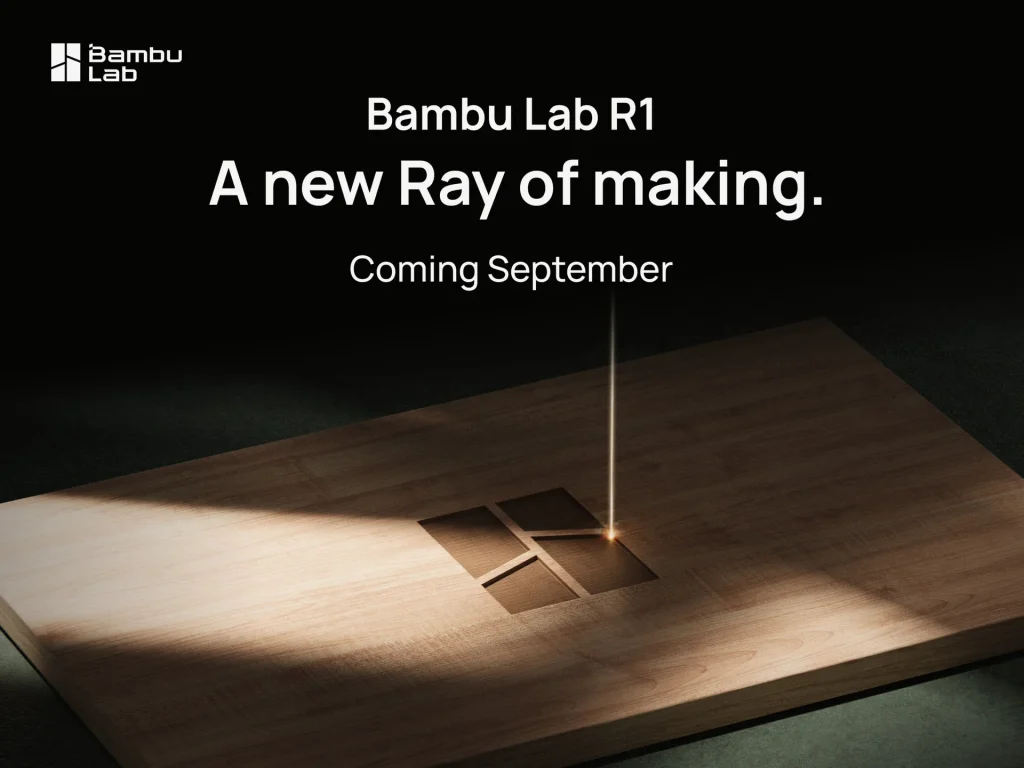
The announcement rolled out in three stages. The August 13 teaser showed only the name, the tagline “A new Ray of making,” and a render of a single beam cutting the four-square Bambu logo cleanly through a light wood board. On September 14, Bambu confirmed the two biggest open questions: the R1 uses a CO2 laser, and it launches on September 22, 2026, under the slogan “Big job. Light work.”
CO2 is the meaningful detail. Unlike the blue diode modules in the H-series, a CO2 laser is a full class of machine associated with serious cutting — acrylic, wood, leather, fabric and coated materials — and the official “up to 3 meters” tease (“from miniature models to full-size floor lamps”) points to a pass-through or extended work area at furniture scale. Forum images of the machine’s own safety labels add two more confirmed details: the R1 is classified as a Class 1 laser product under IEC 60825-1:2014 in its standard enclosed configuration, and installing the optional conveyor feeder reclassifies it as a Class 4 device intended for professional use. Bambu is also promoting a smoke purifier with a 15% launch discount, valid for 60 days after launch.
What is still unknown — as of launch morning — is the exact optical power, work area, cutting capacity per pass, and price. Bambu has been deliberately disciplined about not leaking specifications ahead of the official reveal, and community trackers have warned readers to treat any circulating wattage figure as unverified. Today’s launch event is expected to fill in that spec sheet.
Why the R1 Matters Beyond One Product
The R1 lands in a crowded moment. xTool — the current leader in the consumer laser engraving space — just unveiled its own X1 hybrid platform with swappable laser modules, and Bambu’s entry is widely read as a direct shot across the company’s bow. According to industry coverage, Bambu is also developing a consumer-grade UV printer project alongside the R1, part of a cross-category expansion that some analysts describe as a “maker tool trio”: 3D printing, laser, and now UV printing.
For the desktop manufacturing landscape, the pattern is familiar — the same “less fiddling, more making” philosophy that made Bambu’s printers the default recommendation for beginners is now being aimed at laser cutting, a category still associated with mirrors, alignment paper and fiddly configuration. If the R1 delivers on that promise, a CO2 cutter with Bambu-grade software experience at a competitive price would reset expectations for the entire category.
How TT3DPrint Can Help
At TT3DPrint, we run a 220-machine Bambu Lab fleet for custom FDM printing — figurines, educational tools, prototypes and creative gifts produced daily for customers worldwide. Laser cutting and 3D printing are complementary crafts: flat structural parts, engraved nameplates, acrylic displays and mixed-material projects combine naturally with printed components. Whether you need a one-off custom piece or a batch run with laser-finished details, we can help you design for both processes and deliver ready-to-use results. Contact us to discuss your project, or browse our product range for inspiration.
Conclusion
The Bambu Lab R1 is the company’s first step outside 3D printing: a standalone CO2 laser engraver and cutter, launching today with a confirmed focus on big, furniture-scale work and a safety-first enclosed design. Full specifications and pricing arrive with the launch event. One thing is already clear — the desktop workshop now has a new serious player in the laser category, and “personal manufacturing hub” is no longer just a tagline.
Sources: Bambu Lab official R1 page, Bambu Lab Community Forum announcements, 3DPCC News, All3DP, Ebrun.