ugee Funbox: The 3D Printer Designed for Children
The Rise of Child-Safe 3D Printers
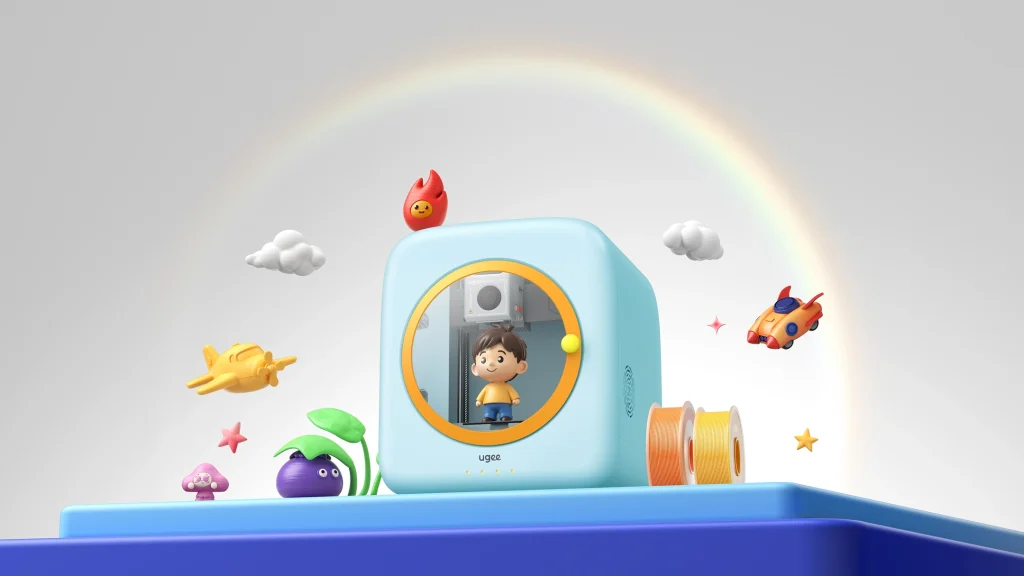
The consumer 3D printing market is undergoing a quiet transformation. While much of the industry’s attention focuses on industrial-grade metal printers and high-speed FDM machines, a new category is emerging — printers designed specifically for children and families. ugee, a Shenzhen-based digital creativity brand, has thrown its hat into this fast-growing ring with the global launch of Funbox, a desktop 3D printer purpose-built for the 4-to-12 age group.
The Funbox arrives at a moment when home STEAM education tools are surging in popularity. Parents increasingly want hands-on technology that teaches children engineering, design, and problem-solving skills without the risks associated with traditional open-frame 3D printers. ugee’s bet is that safety, simplicity, and AI-assisted creativity can unlock a market that most manufacturers have overlooked.
Safety First: Enclosed Design and UL Certification
What sets the Funbox apart from competitors is its uncompromising focus on safety. The machine ships as a fully enclosed unit with a rounded-edge chassis and a 12V low-voltage DC power supply that meets IEC safety standards. This drastically reduces the electric-shock risk compared with mains-powered open printers — a critical consideration when the target user is a seven-year-old.
Inside the enclosure, an H12 HEPA filter paired with an activated-carbon module and a 6010 exhaust fan captures the ultrafine particles and odors that FDM printing inevitably releases. ugee claims this is the largest filtration system in its class, and it’s what enables the company’s boldest usage claim: that Funbox can run overnight inside a closed, carpeted room without ventilation concerns.
The certification stack is unusually heavy for a desktop printer. Funbox carries UL GREENGUARD certification alongside ASTM F963-23, EN71, and EN62115 toy-safety standards. This isn’t just marketing — it’s a clear signal that ugee understands its buyers are parents, not hobbyists. A real-time heating indicator warns when the nozzle is hot during filament changes or calibration, adding another layer of protection for young users.
One-Tap Operation: No Assembly, No Calibration
One of the biggest barriers to entry in consumer 3D printing is the setup process. Bed leveling, screw installation, mechanical calibration — these steps regularly defeat first-time users, let alone children. The Funbox arrives 100% pre-assembled with none of these requirements.
Connectivity is handled over Wi-Fi 6 dual-band through ugee’s proprietary UFun mobile app. The printer reaches a peak speed of 500mm/s and resolves down to a 0.05mm minimum layer height. Three slicing presets — Fast, Standard, and Fine — span the gap between a preschooler’s first print and a teenager’s more demanding project. A built-in 2MP HD camera enables remote monitoring and time-lapse capture, while power-loss resume and automatic filament-jam detection cut down on the failed prints that would otherwise frustrate young makers and their parents.
AI-Powered Design: From Doodle to 3D Model
The most innovative feature of the Funbox is its AI ShapeGen system. This proprietary technology offers three generation modes: voice description, text input, and hand-drawn doodle conversion. Each mode transforms a child’s rough idea directly into a printable 3D model, bypassing the CAD skills that normally gate original design work.
This is a significant leap for educational 3D printing. Traditional workflows require learning software like Tinkercad or Fusion 360 before creating anything original. With AI ShapeGen, a child can sketch a dinosaur on paper, photograph it with the UFun app, and have a printable model ready in minutes. The app also includes a growing library of toys, stationery, animal crafts, and mechanical models, plus serialized free STEM tutorials that walk children through structural design and basic engineering logic.
Open Materials vs. Closed Ecosystems
ugee has positioned the Funbox against the walled-garden model popularized by Toybox, which uses proprietary filaments and a closed ecosystem. The Funbox accepts any standard 1.75mm PLA filament, a choice that lowers long-term running costs and keeps creative freedom in the family’s hands. At an early-bird price of $269 — bundled with seven rolls of standard PLA filament — the total cost of ownership is significantly lower than subscription-based alternatives.
This open-materials approach is particularly relevant for schools and makerspaces that need to manage budgets across dozens of machines. Standard PLA is widely available, affordable, and comes in hundreds of colors, making it ideal for educational projects where variety and cost control matter.
How TT3DPrint Can Help
The growing demand for child-safe 3D printers reflects a broader trend: families and schools want custom 3D printed objects but may not have the equipment or expertise to produce them. At TT3DPrint, we specialize in custom FDM 3D printing for educational tools, figurines, and creative projects. Whether you need personalized learning aids, custom toy prototypes, or batch-produced classroom materials, our 220-printer Bambu Lab cluster delivers high-quality results at competitive prices. We work with standard PLA and PETG materials, and our team can help bring AI-generated designs or hand-drawn concepts to life. Contact us for a quote on your next educational or creative project.
Conclusion
The ugee Funbox represents a new direction in consumer 3D printing — one that prioritizes safety, simplicity, and creativity over technical specifications. As more families discover the educational value of 3D printing, machines like the Funbox will play a key role in making this technology accessible to the next generation of makers, engineers, and designers.
For those who want custom 3D printed objects without investing in their own printer, professional printing services like TT3DPrint offer a practical alternative. From one-off prototypes to batch production, the expertise and equipment of a dedicated 3D printing service can bring any idea — sketched, spoken, or digitally designed — into the real world.