
Royal Society Funds 3D Printing in Hospital Schools
Introduction
Children who spend long periods in hospital or attend specialist schools because of complex health needs often miss out on the hands-on STEM experiences their classmates take for granted. A new national project aims to change that by bringing 3D design and 3D printing directly into hospital education settings across England.
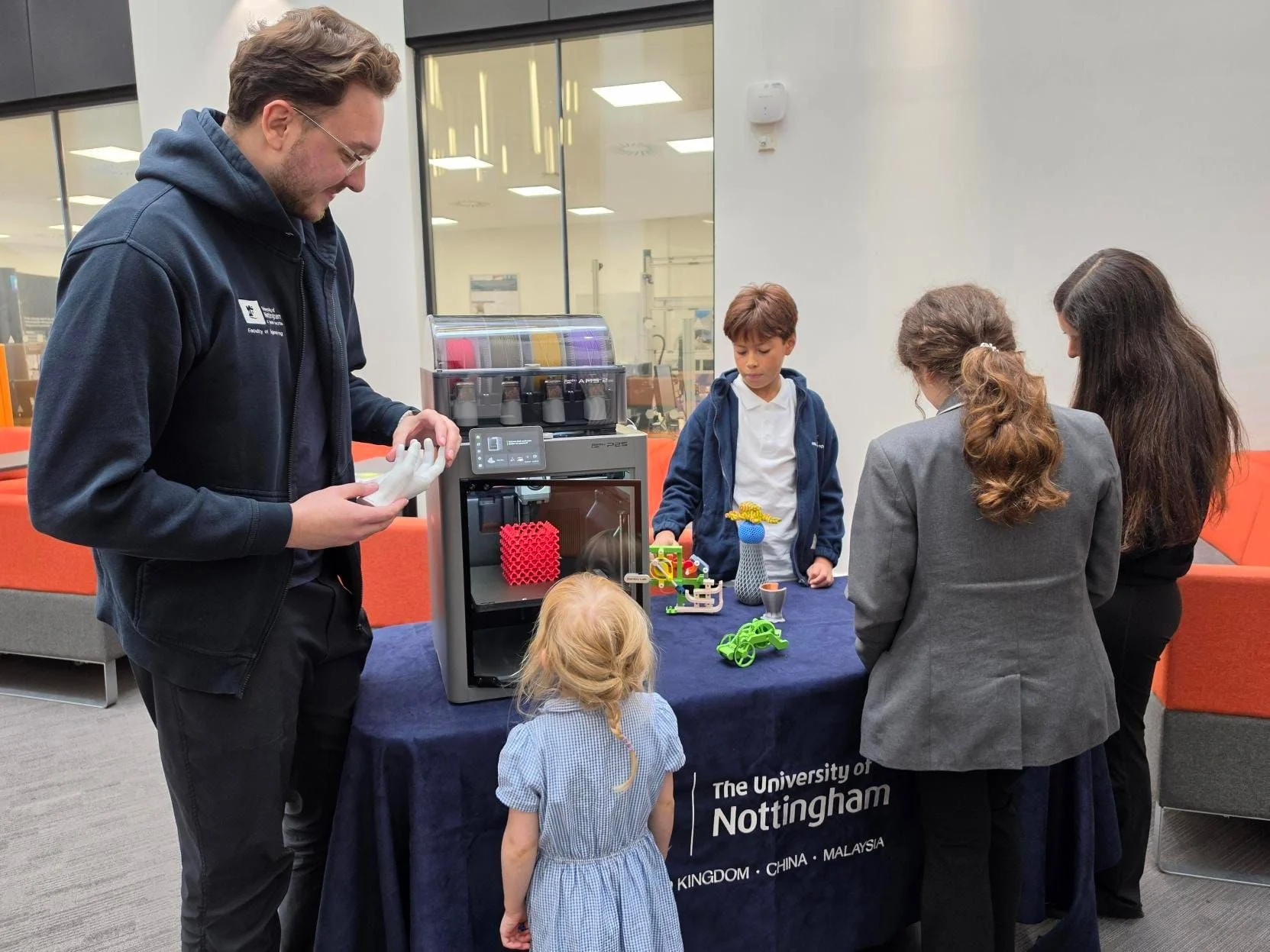
Announced on 21 September 2026, the three-year project is led by the University of Nottingham and funded by a Royal Society Science Community Grant together with the Julia Rausing Trust. Working with The National Association for Hospital Education (NAHE), the initiative will initially involve 25 schools — each receiving its own 3D printer, a national training programme, and support from a local partner university.
What the Project Involves
The project targets the settings where vulnerable young people learn: hospital schools, medical pupil referral (MPR) units, and Child and Adolescent Mental Health Services (CAMHS) inpatient units. Engineers and scientists from universities across the country have volunteered their time to give school staff the skills and confidence to run hands-on investigative projects using 3D design and printing.
Each school runs the programme across a term, built around user-centred design. Students start by examining their own environment and identifying something that could work better — in a hospital setting, that might be a practical aid for a task they find difficult, or a personalised item that makes an unfamiliar room feel more like home. They are then guided through capturing design requirements and defining a design challenge before learning to contribute solutions themselves, from sketching and ideation through to CAD skills and 3D printing.
The term culminates in a showcase event that brings the whole network together to celebrate what has been built. Participating staff and STEM professionals also join regular webinars and an annual in-person workshop to share best practice across the partnership.
Building Skills and Confidence
Professor Ruth Goodridge, who leads the project at the University of Nottingham with Dr Simon Lawes, said the gap is real and urgent. “Children and young people who spend extended periods in hospital or attend specialist schools due to complex health needs often miss out on the enriching, hands-on STEM experiences that their peers take for granted,” Professor Goodridge explained. “Hospital school staff tell us that illness can make a child’s world feel very small, with disrupted education, anxiety and low confidence often affecting their engagement with learning.”
She added that 3D printing offers “an accessible and rewarding way for students to develop new skills, solve problems and create something tangible, providing a real sense of achievement at a time when many aspects of their lives may feel beyond their control.”
Sir Paul Nurse, President of the Royal Society, highlighted why practical science matters: “Schools are where most people first encounter science. Practical science helps students experience the scientific process, evaluate evidence, understand uncertainty, and appreciate how science helps us understand and improve the world.”
More Than Education: A Rehabilitation Tool
Participating schools believe the benefits go beyond the classroom. Teachers have identified opportunities to support cognitive rehabilitation after acquired brain injury — rebuilding skills such as attention, memory, sequencing, and problem-solving through structured design projects.
Recognising that potential, the project is partnering with the NIHR HealthTech Research Centre for Rehabilitation, led by Nottingham University Hospitals NHS Trust, to explore how 3D printing could contribute to children’s rehabilitation and recovery after serious illness or injury. At the University of Surrey — a partner in the coalition — the setting is the Surrey Teaching Centre at Tadworth Court, a medical pupil referral unit for children admitted for rehabilitation following acquired brain injury. Professor Robert Dorey of Surrey said the programme helps young people “develop critical reasoning skills that will support them in later life.”
Stephen Deadman of The National Association for Hospital Education summed up the wider value: “This project will provide vital skills for children unable to access traditional school, giving them some invaluable hands-on experience with specialist equipment… bringing a sense of community and shared achievement.”
Why 3D Printing Works in Hospital Education
Several features make 3D printing especially suited to this environment:
- Low barrier to entry — students can go from a paper sketch to a physical object in hours, without needing advanced workshop equipment.
- Tangible results — a printed part is a concrete achievement learners can hold, which matters for confidence and motivation.
- Cross-curricular skills — the workflow naturally combines design thinking, CAD literacy, materials knowledge, and iterative problem-solving.
- Personalisation — every project can be tailored to an individual student’s needs, from adaptive aids to items that personalise a clinical space.
- Community — shared showcase events connect isolated hospital schools into a national network of peers facing similar challenges.
For education systems worldwide, it is a reminder that affordable desktop 3D printers have turned additive manufacturing from an industrial curiosity into a classroom staple. Projects like this one show the technology’s reach extending to the students who need it most.
How TT3DPrint Can Help
At TT3DPrint, we see the same transformation every day in our own workshop. As a custom FDM 3D printing service working with a fleet of Bambu Lab printers, we produce teaching aids, anatomical models, educational prototypes, and bespoke creative projects for schools, universities, and organisations around the world. If your institution wants to explore what 3D printing can add to your programme — from a single prototype to a full batch of classroom kits — our team can help you turn a design brief into finished parts. Contact us to discuss your project, or browse our product range to see what is possible.
Conclusion
The Royal Society-backed project shows what happens when the 3D printing community — universities, professional bodies, and schools — pulls together for a cause bigger than technology demos. For 25 hospital schools, a desktop 3D printer is about to become a tool for confidence, creativity, and recovery. If the first three years prove what teachers already suspect, that impact will scale far beyond England’s hospital classrooms.
Need Custom 3D Printing?
At TT3DPrint, we specialize in custom FDM 3D printing for figurines, prototypes, educational tools, and creative gifts. Whether you need a one-off prototype or a batch of custom products, we deliver worldwide.
Sources: University of Nottingham, TCT Magazine, University of Surrey, 3D Adept